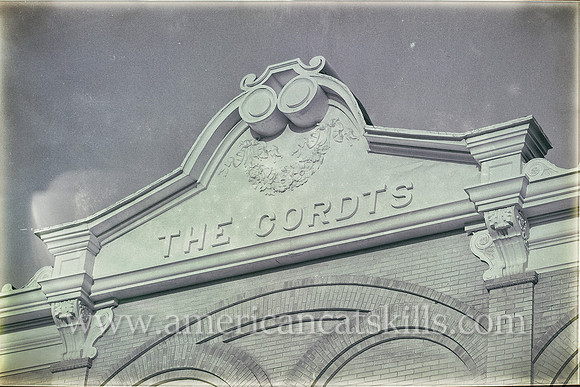
The Cordts
Stockade District, Kingston, Ulster County
The Cordts building is located within the historic Stockade District of Kingston. The building was originally the Romeyn building, named for William H. Romeyn, publisher of the Kingston Journal, and served as Kingston’s post office. The building was designed by W. J. Beardsley, a Poughkeepsie architect who kept an office in Kingston. Over the years the building has been home to a variety of businesses including the Kingston Savings Bank (1874-1885), the Prudential Insurance Company (1900-1915), the Kingston Co-Operative Savings and Loan Association, the law firm of Traver & Murray, the law firm of Cunningham & Traver and The People’s Store (men’s and women’s furnishings). In 1909 Matthew Herzog founded a paint, wallpaper and picture framing store at The Cordts building, a Kingston business that continues to thrive today, over a century later, as Herzog’s Home and Paint Centers.
The Stockade District of Kingston derives its name from a 1658 order by Director General (i.e. Governor) Peter Stuyvesant to have the homes of all settlers in the Dutch colony moved within a defensive fortification. The stockade area was chosen because of steep banks on three sides forming the perimeter. The actual stockade enhanced the natural hillside and consisted of 14-foot high walls made of tree trunks. Villagers would leave the compound during the day to work their farms and return to the compound in the evening. During his 1782 visit to Kingston General George Washington commended Stuyvesant for his military sagacity in planning the stockade.
Today, the Stockade District is listed on the National Register of Historic Places. The eight-block area is bounded by North Front Street to the north, Main Street to the south, Green Street to the west and Clinton Avenue to the east. The streets are laid out today just as they were in 1658. There are eight 17th century stone houses, another dozen buildings from the 18th and early 19th centuries, plus many other architecturally appealing buildings.