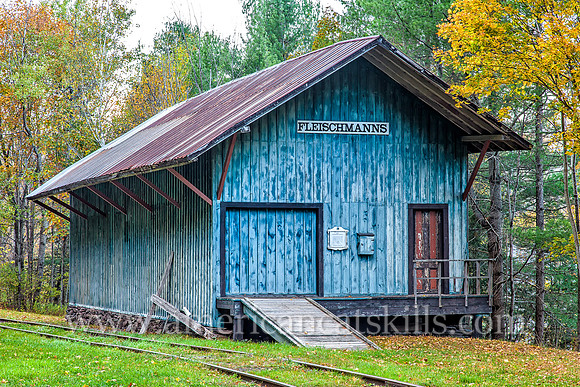
Fleischmanns Station
Fleischmanns, Delaware County
The freight house at the former Fleischmann’s Railroad Station is located along today’s Route 28 outside the small hamlet of Fleischmanns. The freight house operated as part of the Ulster & Delaware Railroad (U&D), which ran from Kingston to Oneonta. The U&D provided passenger service for the thriving Catskills tourist industry and also freight service for the region’s timber, bluestone and agricultural industries. The U&D (through insolvency, acquisitions, mergers and name changes) operated from 1866 until 1954, when it ceased passenger service, and 1976, when it ceased freight service. Today the freight house is maintained by the Delaware & Ulster Railroad (www.durr.org), a tourist railroad operating out of Arkville. The hamlet and railroad station are named for the Fleischmanns family, prominent local landowners of the 19th century and founders of the still existing and successful Fleischmanns bread, food and vodka company.
The 1910 Ulster & Delaware Railroad Company guidebook to the Catskill Mountains poetically described the Fleischmanns area: “Man men of wealth and station have beautiful cottages and grounds here, especially the well known Fleischmann family, which has had so large a share in the development of the place. Many of these handsome homes are on the bluffs south of the track.
There is now a change of landscape; the wild and mountainous aspect peculiar to the Ulster section giving place to the pastoral and placid features of cleared land and agricultural life. You are now entering a dairy land, with its thoroughbred cows, its rich milk and gilt edged butter, the home of the sugar maple and the luscious products of the sap bush. The trickling stream on the right is the East Branch of the Delaware, which soon gathers volume and force as we proceed. The mountain slopes are now more gentle and sparsely wooded. Though yet set with stumps and stones, with an occasional protrusion of rock, they yield more readily to cultivation.”