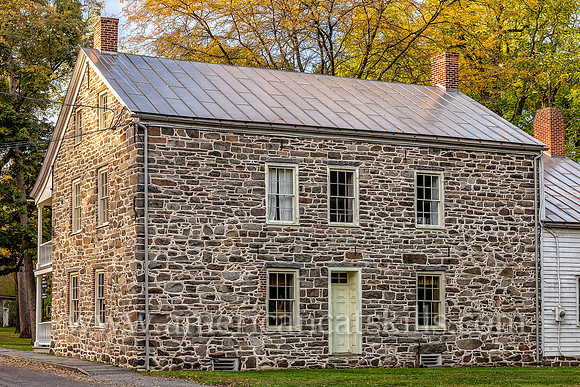
DuBois House
The New Paltz Patent approved by the Governor required the settlers to construct a fort as part of the community. In response, in order to meet this requirement and despite good relations with local Native Americans, the DuBois House, also known as the DuBois Fort or the Old Fort, was constructed in 1705. Although it was designed as a place of refuge, it contained little fortification other than a few gun ports but did meet the letter of the law. It was never used in armed conflict. The house was constructed by Daniel Dubois, the grandson of Louis DuBois, one of the original 12 founders of New Paltz. Remarkably, the house remained in the Dubois family until 1968, or 263 years, when it was sold to the Huguenot Historical Society. Today, the Dubois Fort serves as the visitor center for the Huguenot Historic District.
New Paltz was founded in 1678 by French Huguenots, Protestant followers of John Calvin who had escaped religious persecution in France and emigrated to religiously tolerant countries around the world, including the United States. With the purchase of nearly 40,000 acres of land from the Esopus Indians, the 12 founding families, referred to as the Patentees (as they held the legal patent to the land), quickly left their young Kingston and Hurley homes and established a permanent settlement and farming community along the Wallkill River.
Peaceful Huguenot Street in downtown New Paltz offers a step back in time to these early days of the village. Charming, Dutch-inspired stone houses, many now active museums, provide a glimpse of what life was like in the 17th, 18th, and 19th centuries. Visitors can admire the quality architecture at the Freer House, Abraham Hasbrouck House, Bevier-Elting House, DuBois Fort, Jean Hasbrouck House and the LeFevre House, as well as a reconstructed 1717 church. There is also an 18th century burial ground, a visitor center, educational exhibits and many of the homes are open for tours. Huguenot Street, marketing itself as “the oldest street in America with its original houses”, is listed on the register of National Historic Landmark Districts.