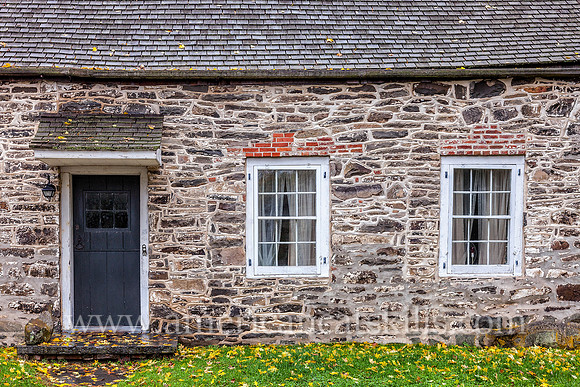
Freer House
Hugo Freer, one of the original 12 founders of New Paltz, built the 1½ story home in 1694, with Hugo’s descendants adding rooms in 1735 and 1776. Hugo was a prominent member of the community, including being named deacon of the first church in the village. Hugo is buried in the nearby Crispell Memorial French Church and Burying Ground. In 1720, Hugo’s granddaughter Sarah and husband Johannes Louw inherited the house. The house then remained in the Low family until the early 20th century, changed hands several times outside the family before being purchased in 1955 by the Huguenot Historical Society.
New Paltz was founded in 1678 by French Huguenots, Protestant followers of John Calvin who had escaped religious persecution in France and emigrated to religiously tolerant countries around the world, including the United States. With the purchase of nearly 40,000 acres of land from the Esopus Indians, the 12 founding families, referred to as the Patentees (as they held the legal patent to the land), quickly left their young Kingston and Hurley homes and established a permanent settlement and farming community along the Wallkill River.
Peaceful Huguenot Street in downtown New Paltz offers a step back in time to these early days of the village. Charming, Dutch-inspired stone houses, many now active museums, provide a glimpse of what life was like in the 17th, 18th, and 19th centuries. Visitors can admire the quality architecture at the Freer House, Abraham Hasbrouck House, Bevier-Elting House, DuBois Fort, Jean Hasbrouck House and the LeFevre House, as well as a reconstructed 1717 church. There is also an 18th century burial ground, a visitor center, educational exhibits and many of the homes are open for tours. Huguenot Street, marketing itself as “the oldest street in America with its original houses”, is listed on the register of National Historic Landmark Districts.