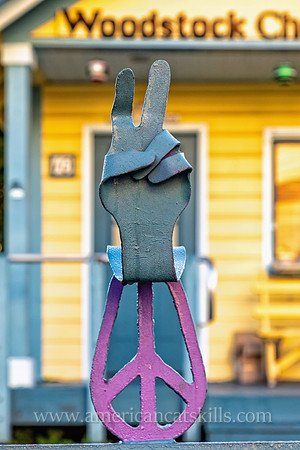
Woodstock, Catskills
Although its origin is unclear and subject to debate, the widespread use of the “V” hand gesture (with palm facing outward) began in England during World War 2 as a sign for victory. The British Broadcasting Company in 1941 ran a “V for Victory” campaign publicizing the hand gesture as a way to galvanize the besieged public during the onset of devastating German attacks. It was further popularized by England’s Prime Minister, Winston Churchill, who was often seen flashing the sign to the public. The simple hand gesture would quickly become internationally recognized as the symbol for victory.
The “V” hand gesture its way to the United States in the 1960s and 1970s, often being associated with the counter-culture “hippie” lifestyle. The sign initially symbolized “peace” or “love” rather than “victory”, i.e. (“peace, not war”), but slowly took on a variety of meanings such as greeting or welcome, protest (particularly of the Vietnam War, and in rallies for nuclear disarmament), defiance, freedom, and solidarity. Although not used as frequently today, the iconic gesture continues to be universally recognized in pop culture, by friends hamming it up in a photograph, or in protests from around the world.