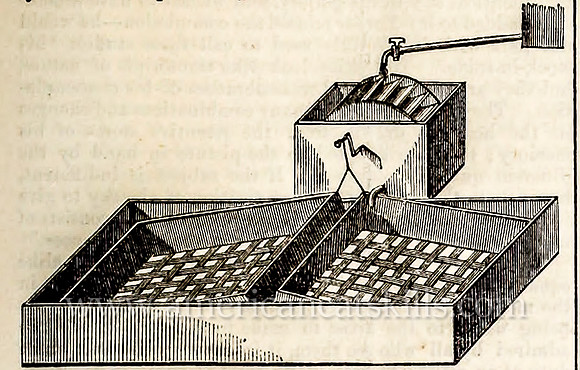
Photographic Washing Machine by William England
“The washing arrangements are very excellent. After the fixed prints are received three or four rapid changes of water to remove the bulk of the hypo, they are transferred to the washing machine, an invention of Mr. England, and used by him for the past ten years, diagram of which we give. It consists primarily of a large trough 7 feet long, by 4 fee 6 inches wide, and 11 inches deep. Placed in this are two trays with lattice work, made of gutta-percha strips, at the bottom. Just above, supported by a bracket on the wall, is a box containing a water-wheel turned by the stream from a tap just above it.
The two trays are connected with this wheel by a rod attached to a crank, and as the wheel revolves the trays are kept in a constantly oscillating motion, which serves the double purpose of preventing the prints from sticking together, and of securing more effectual washing than is effected by great soaking. The water which turns the wheel passes through a pipe at the bottom of the wheel-box into the washing trays; and about once in every hour, the large trough having become full, brings into action a syphon, which empties it in ten minutes, leaving the prints to drain for a time, resting on the gutta-percha lattice work. The washing, thus managed, is found to be very effectual.
The prints are removed each morning after a night’s washing, and placed in a straight heap in a screw press, by which al the water is squeezed out of them, which is a more effectual aid to drying than blotting off; and when spread on canvas frames the prints rapidly dry flat and even, with little curling or cockling.” (“Visits to Noteworthy Studios. Mr. England’s Establishment at Notting Hill.” The Photographic News. Vol. 12, No. 502. April 17, 1868. pp. 185.)