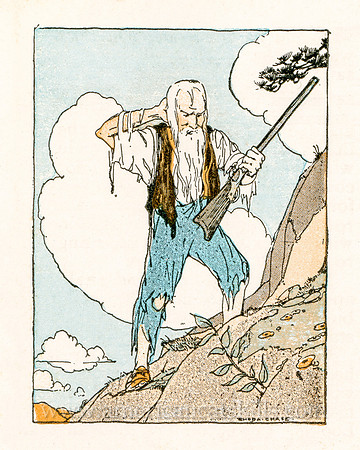
Rip Awakes Twenty Years Later
This miniature version of the Rip Van Winkle story, measuring only 2 3/16 inches by 2 3/4 inches, served as an advertising booklet for Packard Pianos. The 12-page booklet contains a short, summarized version of the Rip Van Winkle story along with six colorized illustrations. The advertisement for Packard Pianos, which noted that “you can’t get a better piano at any price,” can be found on the back page. The booklet was published in 1916 by John H. Eggers of New York.
Each of the six images in the Rip Van Winkle booklet were created by illustrator Rhoda Campbell Chase (1881-1959), whose work can be found in numerous school and children’s books. Rhoda was the daughter of Henry Seymour Chase (1853-1889), a well-known marine artist, and Laura Emeline Eames Chase (1856-1917), a member of the Daughters of the American Revolution, a graduate of Iowa State University dental school and the first woman accepted as a full member of the American Dental Association.
Following in her father’s footsteps Rhoda would become a well-respected artist. She attended the St. Louis School of Fine Arts, lived in Paris while working with Theophile Steinlen as a mentor and studied at the Art Students’ League in New York City.
Beginning in 1917 Chase illustrated a new line of products issued by Harper & Brothers called the Bubble Book, an innovative product which combined books with records. The Bubble Book series, marketed with a slogan of “books that sing,” were aimed at children who could learn to read while singing along to the records at the same time. The record/book combination proved immensely popular, with millions sold every year after its initial release. For more information on the history of the Bubble Book series, see Jacob Smith’s book titled Spoken Word: Postwar American Phonograph Cultures.
For approximately 45 years, from the mid-1910s to her passing in 1959, Rhoda lived in the art-friendly village of Woodstock, New York in the Catskill Mountains, near the setting for the Rip Van Winkle story. She was an active member of the Christian Science Church in Woodstock. Rhoda died on August 1, 1959 at Kingston Hospital in Kingston, New York and was survived by her brother Irwin Chase, of Deep River, Connecticut; a nephew, Rear Admiral Irwin Chase Jr., USN, Ret., of Deep River; and a niece, Mrs. Roger C. Cunningham of Ann Arbor, Michigan. Rhoda Campbell Chase is buried at Bellefontaine Cemetery in St. Louis, Missouri.