Freedom Isn't Free
Lackawaxen, Pennsylvania
The Battle of Minisink Ford took place during the American Revolution on July 22, 1779 between British Loyalists and their Native American supporters, led by Mohawk Chieftain Joseph Brant, versus approximately 120 American militiamen from New York and New Jersey, led by Colonel John Hathorn. In response to Brant’s attack two days prior at the frontier settlement at Peenpack (Point Jervis), American militia sought to intercept Brant’s escape up the Delaware Valley, catching up with him and his forces at Minisink Ford.
With the American militia preparing to ambush Brant as he prepared to cross the Delaware River into Lackawaxen, and with Colonel Hathorn having split his forces into a group of skirmishers and two main units, an accidental rifle discharge from a militiamen unfortunately alerted Brant. Upon his discovery, Brant responded quickly and forcefully, attacking the American militia before they were able to fully deploy, splitting the American forces. One group of the Americans retreated to the top of the hill overlooking the river to regroup and regain their strategic advantage. Unfortunately, only about 50 of the original group of 120 American militiamen were left, the separated forces having dispersed or having been killed or wounded. Brant outflanked the Americans and broke through the new small defensive square of the Americans. The Americans were routed, with 47 militiamen killed. Brant lost approximately seven men. It was a decisive British victory.
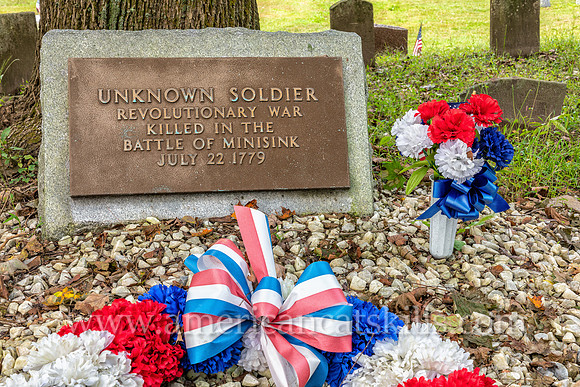
Located at Saint Mark’s Church in Lackawaxen, Pennsylvania, directly across the Delaware River from Minisink Ford, is the burial site for an Unknown Soldier that died in the Battle of Minisink Ford on July 22, 1779. Because of the battle’s location, being in rough country and far removed from any roads, the bodies of the soldiers killed that fateful day remained there for over 40 years. Later still, in 1847, yet another body of an American soldier was discovered under a rock ledge by a farmer looking for his cow. The remains, identified by remnants of his uniform, were removed to Lackawaxen and buried on the shores of the Delaware River. Today the local chapter of the Veterans of Foreign Wars takes care of the gravesite and conducts an annual memorial service to commemorate the Battle of Minisink Ford.