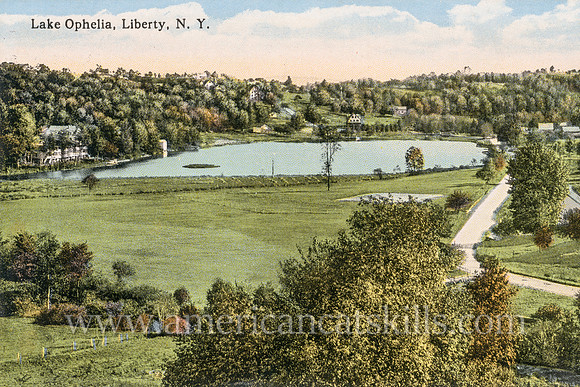
Lake Ophelia, Liberty, N.Y.
In 1977 Delbert Van Etten, Liberty village historian, beautifully wrote of the history of Lake Ophelia: “In late September of 1899 approximately 52 acres of land were acquired from Jonathan B. Nichols, Basley Gerow and Gertrude Delamarter for the purpose of building a proposed lake on the flats just south of and adjoining the Village of Liberty.
The property was acquired by William H. Clark and his wife, Ophelia Stoddard Clark, after whom Lake Ophelia received its name. The stone and earth dam must not have been completed, or at least the lands not covered with water until after October 1, 1900, because Basley Gerow reserved the right to pasture the cleared portion of the 31 acres he sold the Clarks until this date.
The Clarks had in mind to make a large amusement resort out of the area and in the winter of 1901 the large Lake Ophelia Pavilion was constructed on the east shore of the lake in the vicinity of the present Grossinger ski area. This was a huge two story building with a third additional story for living quarters on the south. There were bowling alleys, a roller skating rink and the largest dancing floor in the county. Ice cream and soft drinks were served outside on the open porches overlooking the lake.
Many elaborate functions and dances were held at the Pavilion over the years. The Liberty Odd Fellows held annual picnics. Water Carnivals, Receptions and Dances there to the music of Nutting’s Orchestra.
If one tired of the activities at the Pavilion, they could rent a boat and row around the lake, perhaps to the island with its flag pole or just stroll arm in arm along the board walk and cross over the rustic bridge over the inlet.
I am told the lake was especially beautiful when the shores were rimmed with the flowering wild purple iris and the blue forget-me-nots.
The woods behind the lake was filled with trails where horseback riders from the Gerow, Clements and Nichols boarding houses rode.
Even in the dead of winter the area was busy with ice skaters. The local businessmen used to put up lights at the lake for night time skating.
An early morning fire on October 19, 1911 burned the great pavilion and thus began the downfall of Lake Ophelia.
In July of 1914 the Clarks conveyed their interest in the property to a Mr. Charles W. Hamburger, who had great expectations of building another large pavilion, this time on the western shore near the main highway and also planned to dredge and deepen the lake. The lake had always been shallow and over the years it had gradually been silting in or filling with dirt washed in by the streams during the heavy rains.
Mr. Hamburger’s dreams, however, were never to be fulfilled. In September of 1915 he sold off 8 ¾ acres of the property to Abram Van Leeuwen and in 1916 his heirs sold the balance of the property to Anthony D. Boulanger who, in turn, conveyed his interests to Albert Akerley.
Mr. Ackerly sold off a few small building lots and after his death the property was acquired by the Grossinger Hotel.
Sometime previous to this, probably during Mr. Boulanger’s or Mr. Akerly’s ownership, the dam was opened and the lake was allowed to drain, so that in later years small trees and brush filled the area.
In the middle 1950’s the State of New York build the present Route 17 Quickway up through the center of the bed of the lake and thus just about all the evidence of Lake Ophelia has been destroyed. However, the area still is referred to as Lake Ophelia, even though the lake disappeared so many years ago.”
Source: Delbert Van Etten. “Lake Ophelia.” Liberty Evening News. March 10, 1977.
--------------------------------
The local newspaper carried the obituary of the man responsible for building the Lake Ophelia attraction: “Some 12 years ago, Lake Ophelia, of Liberty, with its dance pavilion (largest in Sullivan County), its bowling alleys, roller skating rink, boating, and other sports and diversions, was one of the outstanding resorts of the section. All these features were recalled by many local and county residents when John T. Clark, who built the place, died Sunday in Maplewood, N.J.
John T. Clark founded one of the oldest and largest stevedore firms in the Port of New York. He was 82 when he died.
The builder of Lake Ophelia once owned property on Carrier street in Liberty, and with his wife, who is dead (a second wife survives), lived there. He was married to Ophelia Stoddard, daughter of George Stoddard, who lived on the Ferndale road. It was after his wife that the resort place was named.
It contained eight bowling alleys, roller skating rink, pool and billiard tables, and the dance pavilion was large enough – in the words of Ben Gerow – to accommodate “36 square sets.” It was one of the amusement meccas not only of Liberty but of Sullivan County.
But, the pavilion burned down and when that happened Mr. Clark left Liberty. He sold the place to Albert Ackerly and subsequently it was acquired by Grossinger, owner of the hotel bearing his name.
Clark had an interesting career. He grew up among the seafaring folk of Nova Scotia, and at the age of 13 shipped on a windjammer to Europe. In the next seven years he traveled on many clippers to the Far East, East Africa, and Europe. He was in business in New York for 62 years.”
“Man Who Built Up Lake Ophelia at Liberty Dies at 82.” Sullivan County Republican.
--------------------------------
“John Clark a rich stevedore built a dam on the Mongaup Stream for his son William who married Ophelia Stoddard, a very pretty girl, as a livelihood for them. The lake was 250 feet wide and a half mile long, they had a dozen boats for hire and a dance pavilion as thousands of summer boarders came up from the city for two months for their vacation. In winter there was ice skating for the Liberty young people to enjoy, and a bar. Lake Ophelia was the name. The pavilion burned down in 1914. Many years later a four lane highway was built and went through where the lake used to occupy. William H. Clark b. 1894; d. Upper Montclair NJ Oct. 11, 1915. His wife, Ophelia Stoddard, was the sister of Cora and Hannah Stoddard. Will and Ophelia had a son, George, b. 1904.” Source: Kathy Lynn Goton Emerson. The Life of a Plodder: Fred Gorton’s 95 Years.