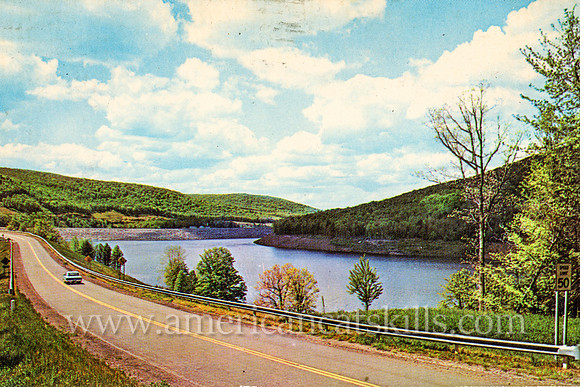
Cannonsville Reservoir
Delaware County
This vintage postcard titled “Cannonsville Reservoir” was taken by well-known Catskills photographer Bob Wyer of Delhi, New York.
The Cannonsville Reservoir is located in the towns of Tompkins and Deposit in Delaware County, New York, about 120 miles northwest of New York City. The reservoir is named for the former town of Cannonsville that was founded in the late 18th century. In turn, the town was named for Benjamin Cannon, an early local resident who served as the town’s first postmaster.
The reservoir was constructed over several years beginning in 1954. Several towns, including Cannonsville, Granton, Beerston, Rockrift and Rockroyal, were destroyed during the construction. Approximately 941 local residents were displaced, 94 farms destroyed, homes were moved or burned, 19,910 acres were submerged and 2,150 graves from 11 different cemeteries were reinterred. The Cannonsville Reservoir was placed into service in 1964. The town of Cannonsville stood near the banks of the Delaware River at the junction with Trout Creek.
The reservoir, formed by damming the West Branch of the Delaware, is 12 miles long, covers an area of 4,703 acres and has a shoreline of 61.1 miles. It has a maximum depth of 121 feet, an average depth of 61 feet and hold approximately 95.7 billion gallons of water at full capacity. The reservoir forms a critical part of the water supply system for New York City.
Bob Wyer is one of the most prolific photographers in the history of the Catskills. His photographic career included shooting just about everything, such as passport photos, chauffer licenses, hunting licenses, high school yearbooks, formal portraits, special occasions such as birthdays and weddings, young babies, local stores, hotels and businesses, accidents, insurance claims, crime scenes, landscapes, parades and local news events. There was nothing that Bob couldn’t and wouldn’t photograph. Upon his retirement, Bob donated his extensive collection of over 150,000 photos to the Delaware County Historical Association. The collection is a virtual time capsule of the region from the late 1930s to the 1970s.