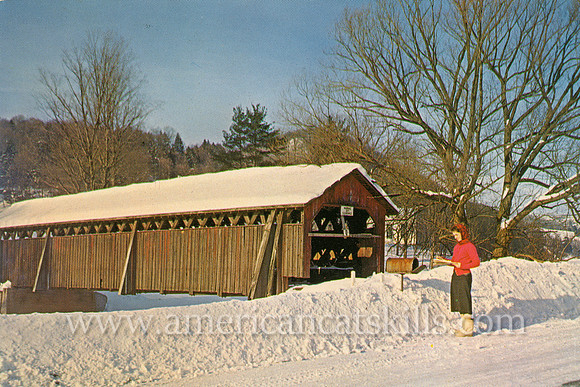
Fitch's Bridge
East Delhi, Delaware County
Vintage postcard of a woman in red sweater getting her mail at a snow-covered Fitch’s Covered Bridge as it spans the Delaware River at East Delhi in Delaware County, New York. The postcard was published by Bob Wyer, located at Delhi, New York. It was never mailed.
The historic Fitch’s Covered Bridge was constructed in 1870 by James Frazier and James Warren at a cost of $1,900. The bridge is a single span, one lane wide, constructed using native materials and is 106 feet long as it spans the West Branch of the Delaware River. The bridge was originally located on Kingston Street in Delhi but was moved in 1885 when the town decided to replace the covered bridge with a newer, more durable iron structure. Instead of destroying the relatively new bridge (constructed only 15 years prior), it was moved several miles upstream to its current location. The historic bridge was recently restored in 2001 at a cost of $425,000. Fitches Covered Bridge is listed on the National Register of Historic Places.
According to the Fitch family website, the bridge is named for Dr. Thomas Fitch (1774-1849) and his younger brother Dr. Cornelius Root Fitch (1783-1846). “Thomas bought a farm at the (site of the future) bridge on the river in 1803. When he left Delhi for Philadelphia in 1806, he sold the farm to Cornelius, who continued to practice medicine in Delhi for 33 years.”
Bob Wyer is one of the most prolific photographers in the history of the Catskills. His photographic career included shooting just about everything, such as passport photos, chauffer licenses, hunting licenses, high school yearbooks, formal portraits, special occasions such as birthdays and weddings, young babies, local stores, hotels and businesses, accidents, insurance claims, crime scenes, landscapes, parades and local news events. There was nothing that Bob couldn’t and wouldn’t photograph. Upon his retirement, Bob donated his extensive collection of over 150,000 photos to the Delaware County Historical Association. The collection is a virtual time capsule of the region from the late 1930s to the 1970s.