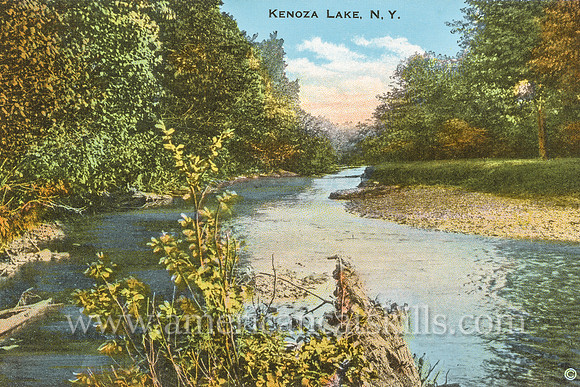
Kenoza Lake, N.Y.
The hamlet of Kenoza Lake is located in Sullivan County, New York. The hamlet, and the physical lake from which it was named, was once called Pike Pond.
James Eldridge Quinlan wrote in his 1873 History of Sullivan County of the early days of the Pike Pond hamlet, “Pike Pond. This place received its name from a pretty natural pond, upon the banks of which is situated. Pike were found here by the early settlers, having been introduced from the Delaware by the Indians, or soon after the region was occupied by the whites. Although the lake is not large, its outlet furnishes a valuable water-power. A man named Woodruff had a saw-mill here in 1814. Subsequently a grist-mill, tannery, etc., were erected on the stream. Blake Wales, jr., at first was interested in the tannery, and it was subsequently owned by Gideon Wales, Osmer B. Wheeler and Nathan S. Hammond. The last two parted with their interests, which finally passed into the hands of Gideon Wales. The magnitude of his business may be estimated when we state that in 1866, he, in conjunction with Daniel T. Stevens, purchased a tract of bark-land of Madame Berthemy, for which they paid $24,500, cash. Gideon Wales was a member of the last Constitutional Convention of this State. Among other residents of Pike Pond we may mention Nathan Moulthrop, Stephen W. Gedney, and William Bonesteel. Mr. Moulthrop was in early life a sailor, and rose to the rank of captain. Becoming weary of a wandering life on the ocean, he for a time indulged in the pleasures of domestic life in Dutchess county. In 1828, he removed to the verge of the settled country at Pike Pond, where he continued to reside until his death in September, 1851. He was a gentleman of many virtues, and among them was that of a generous and genial hospitality. The herald of righteousness, as he wended his weary way over the hills and through the valleys of this then wilderness country, always found rest, refreshment and congenial society under the roof of Captain Moulthrop.
The post-office at Pike Pond was established in March, 1851, with Gideon Wales as post-master.
Pike Pond contains one church (Methodist Episcopal) which was built in 1850. Rev. John Davy labored here at an early day, and organized a “class.”
The lake’s name was eventually changed from Pike Pond to Kenoza Lake, to make it more appealing to visitors as tourism in the region boomed. Blake Wales, the hamlet’s postmaster, chose the name Kenoza Lake from the John Greenleaf Whittier (1807-1892) poem of the same name. The name officially changed in 1890.
This vintage postcard, depicting a peaceful river scene, was published by photographer Otto Hillig of Liberty, New York. The postcard was never mailed.
John Greenleaf Whittier
“Kenoza Lake”
AS Adam did in Paradise,
To-day the primal right we claim:
Fair mirror of the woods and skies,
We give to thee a name.
Lake of the pickerel!—let no more
The echoes answer back, “Great Pond,”
But sweet Kenoza, from thy shore
And watching hills beyond,
Let Indian ghosts, if such there be
Who ply unseen their shadowy lines,
Call back the ancient name to thee,
As with the voice of pines.
The shores we trod as barefoot boys,
The nutted woods we wandered through,
To friendship, love, and social joys
We consecrate anew.
Here shall the tender song be sung,
And memory’s dirges soft and low,
And wit shall sparkle on the tongue,
And mirth shall overflow,
Harmless as summer lightning plays
From a low, hidden cloud by night,
A light to set the hills ablaze,
But not a bolt to smite.
In sunny South and prairied West
Are exiled hearts remembering still,
As bees their hive, as birds their nest,
The homes of Haverhill.
They join us in our rites to-day;
And, listening, we may hear, erelong,
From inland lake and ocean bay,
The echoes of our song.
Kenoza! o’er no sweeter lake
Shall morning break or noon-cloud sail,—
No fairer face than thine shall take
The sunset’s golden veil.
Long be it ere the tide of trade
Shall break with harsh-resounding din
The quiet of thy banks of shade,
And hills that fold thee in.
Still let thy woodlands hide the hare,
The shy loon sound his trumpet-note,
Wing-weary from his fields of air,
The wild-goose on thee float.
Thy peace rebuke our feverish stir,
Thy beauty our deforming strife;
Thy woods and waters minister
The healing of their life.
And sinless Mirth, from care released,
Behold, unawed, thy mirrored sky,
Smiling as smiled on Cana’s feast
The Master’s loving eye.
And when the summer day grows dim,
And light mists walk thy mimic sea,
Revive in us the thought of Him
Who walked on Galilee!