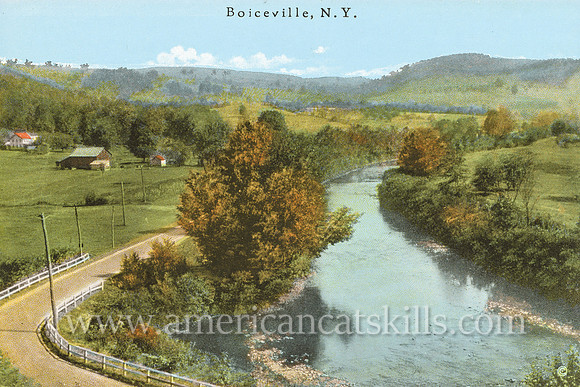
Boiceville, N.Y.
The community of Boiceville is located at the intersection of Route 28 and Route 28A in the town of Olive in Ulster County, New York. The community is home to the Emile Brunel Studio and Sculpture Garden, which is listed on the National Register of Historic Places.
The community of Boiceville is named for Lemuel Boice. Alphonso T. Clearwater in his 1907 The History of Ulster County, New York wrote of Lemuel. “. . . Lemuel Boice, who was born at Shokan, Olive Township, May 5, 1819. Lemuel Boice was engaged in farming, which occupation he followed but a few years, when he became interested in the tanning business. He built a tannery at Boiceville, where he was also engaged in lumbering. He was the leading citizen in the town, was very energetic and controlled one of the largest tanneries in the county. The village of Boiceville was named for him. He remained there until about 1865, when he returned to Shokan and took up farming and lumbering. About the year 1876 he took the contract for building the roadbed and erecting the arches and bridges on the railroad between Arkville and Delhi. On July 14, 1842, he married Mary Ann Brinck, of the town of Olive, and eight children were born to them, of whom Zadoc P. is next youngest. The mother died in June, 1874, and March 30, 1876, Mr. Boice took for his second wife Mary C. Hill. Mr. Boice served one term as Supervisor, in the year 1858.”
Dr. James Sullivan in his 12-volume The History of New York State, 1523-1927 also wrote of the founder of Boiceville. “Lemuel Boice was born May 5, 1819, at Shokan, in the old stone house against the hill, where his father, Peter Boice, and grandfather, John Boice, were also born, both of whom were farmers and leading men of their day.
Lemuel Boice only received a limited education in the district school of that period, but developed into a man of intelligence and one of the best informed on general topics in the township. He started with farming, then to peeling, getting out and preparing bark for tanneries. Later he built a tannery at Boiceville; also engaged in the lumber business, and "Boiceville," it is said, was named for him."
In 1865 or 1866, he went to the old homestead, again taking up farming and lumbering, owning two or three sawmills. About 1870 Lemuel Boice built the Hamilton House, a large brick hotel and store property which stood as a monument to him until the New York City water supply acquire and destroyed the same for reservoir purpose. In 1876-77 he took the contract for grading the railroad, building arches and bridges, for the railroad between Arkville and Delhi, doing this work as far as it went; but the road was not completed and was abandoned.
Up to this time he was one of the most successful men, financially, in this locality, but lost heavily on this railroad contract. He was a self-made man, of great strength of character, and one of the most active in the country, and up to his seventy-fifth year was full of life and energy. He was always an ardent Republican and quite active in political matters. He was elected supervisor in 1858, being one of the leaders of the party at that time. He has always been a public-spirited citizen and highly esteemed and respected by all classes of society; he died December 2, 1899.
Lemuel Boice married Mary Ann Brinck, on July 14, 1842, she died in June, 1874. They had eight children; 1. Horace, born July 24, 1843; married Mary David. 2. Nancy, born January 23, 1845; married Alonzo G. Davis. 3. Ellen, became the mother of Lewis Brown. 4. Lewis, born September 23, 1849; married Sarah Boice. 5. Elizabeth, born January 6, 1852; married Isaac M. Davis. 6. Leland, born June 14, 1854; married Josephine Ennist. 7. Zadoc P., born July 29, 1858; married Adelia Elmendorf. 8. Orpha, born April 20, 1862; married George Siemon. On March 30, 1876, he married his second wife, Mary C. Hill, by whom he had no children.”
The postcard was published by photographer Otto Hillig of Liberty, New York. The postcard was never mailed.