
Stratton Falls at Roxbury, New York: A History and Photographic Study
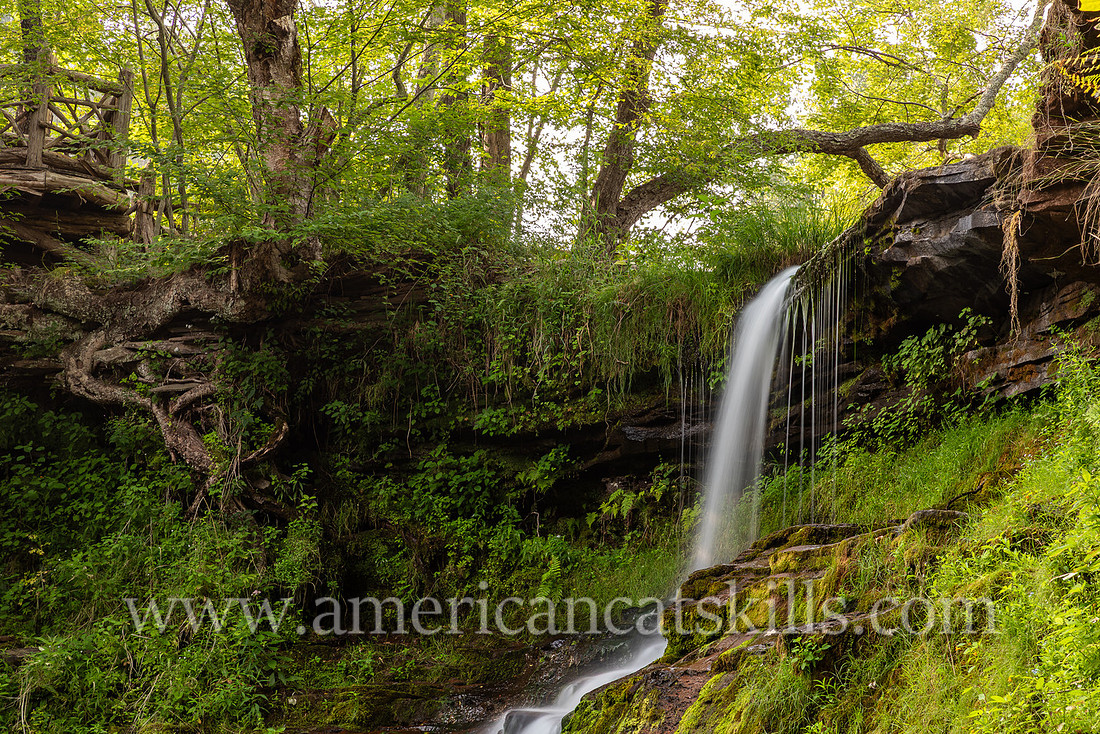
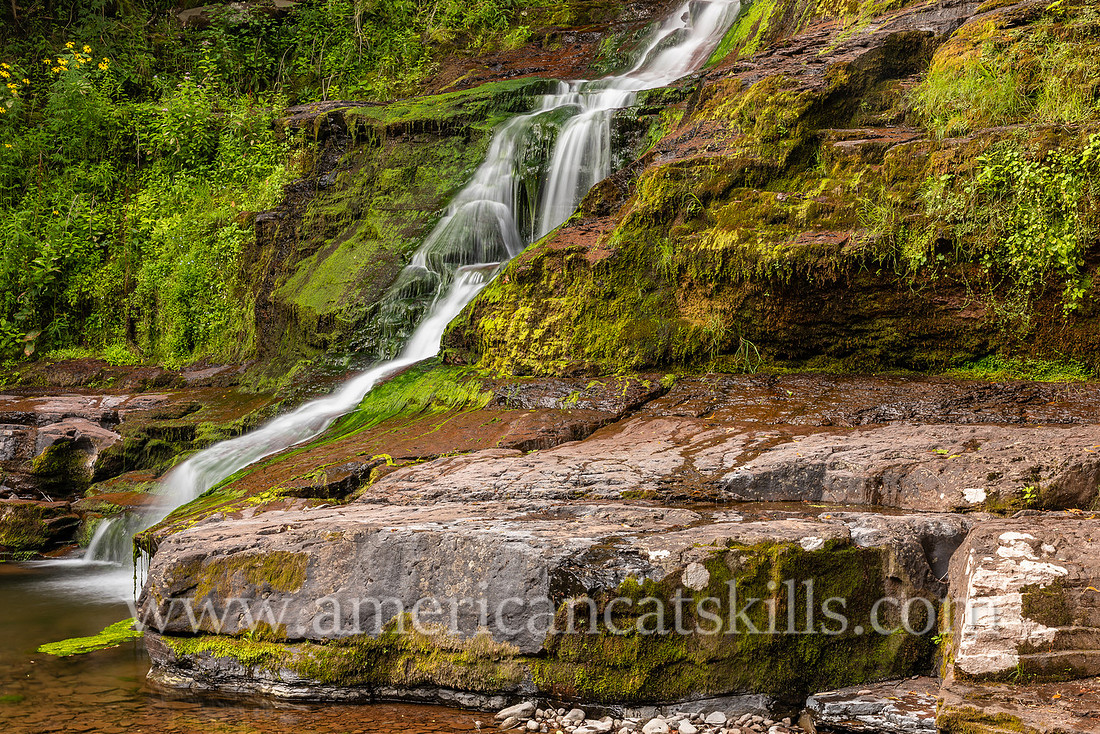
Stratton Falls refers to both the beautiful 50-foot waterfall located in the town of Roxbury, New York and the small rural community that once thrived around the falls.
Stratton Falls takes its name from Joseph and Samuel Stratton, brothers who fought in the Revolutionary War and settled in the falls area in the early 1790s.



Joseph Stratton (1751-1827)
Joseph Stratton was born in July 1751 in Fairfield, Connecticut. He was a soldier in the American Revolution, after having enlisted on July 19, 1775 at Fairfield with his father and his brother Stephen. He served as a Corporal in the 7th Regiment, which was ordered by General George Washington to Boston camps on September 14, 1775, and was there assigned to General Sullivan’s brigade at Winter Hill, on the left of the besieging line. The regiment then returned to Connecticut, where it served as minute men along the sound, and was called out during various alarms during the war. Joseph was at Fairfield when the town was burned by the British.
In 1778, Joseph married Eunice Berry Middlebrook, with whom he eight children.
About 1792, Joseph settled in Roxbury, New York, where he and his brother Samuel were among the first settlers. His farm was located two miles below the present village of Roxbury. The beautiful Stratton Falls, located on a small branch of the Delaware River, were located on his farm.
Joseph arrived in the area when it was still an unbroken wilderness, only reached by sturdy settlers by cutting the brush and logs before them, and carrying their household goods on an ox sled.
Joseph Stratton passed away on May 11, 1827 and is buried at the Tyler Cemetery in Roxbury, New York.
Samuel Stratton (1755-1838)
Samuel Stratton was born in 1755 in Fairfield, Connecticut. He served in the American Revolution after having enlisted in 1776, under Captain Ebeneezer Hill, in Colonel Jonathan Dimon’s regiment, and marched to New York City. He remained with his company until after the British had taken New York, when he was discharged near Kingsbridge.
In March 1777, Samuel enlisted to serve during the war in the same regiment under Captain Elphalet Thorp. He was in the battles of Ridgefield, Fairfield and Norwalk, and was in service when Fairfield was burned.
He was also a soldier in the War of 1812.
In 1779 Samuel married Grace Darrow, with whom he had six children.
Around 1792 he settled in Roxbury, New York where he bought land and cleared a farm, while also engaging in the manufacture of woolen goods, and built a large mill just below Stratton Falls.
Samuel Stratton passed away on October 3, 1838.
Crossroads at Stratton Falls
The 50-foot Stratton Falls is located on the Mill Creek, which runs into the East Branch of the Delaware River below the village of Roxbury.
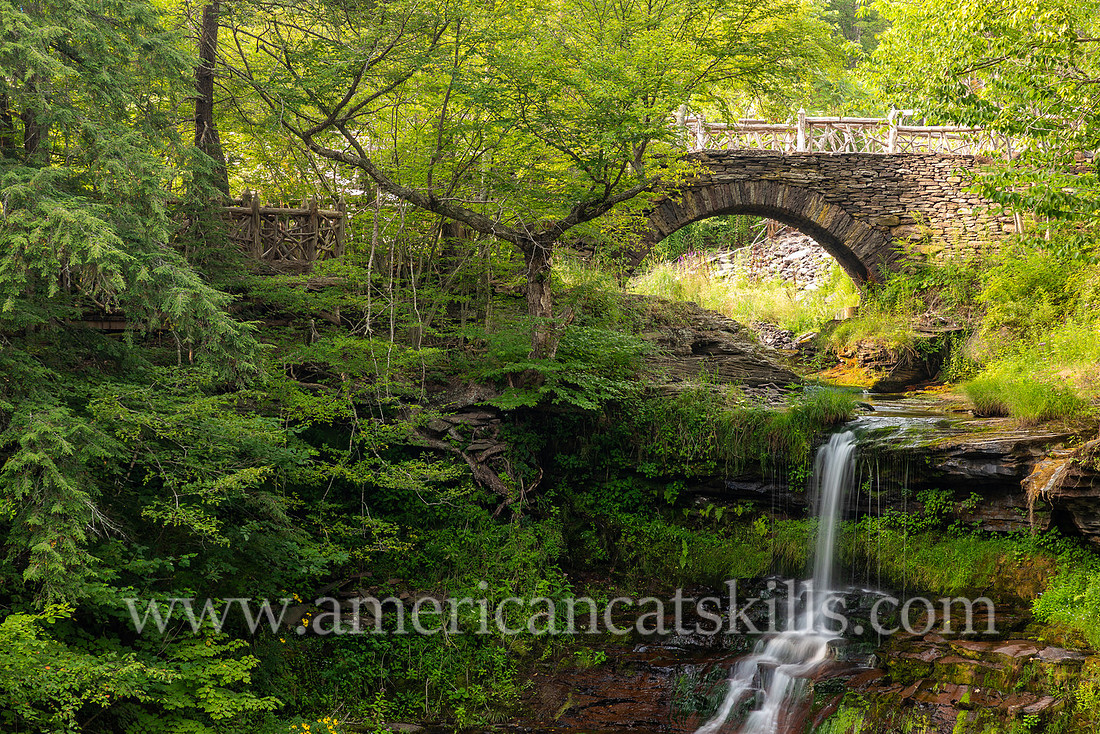
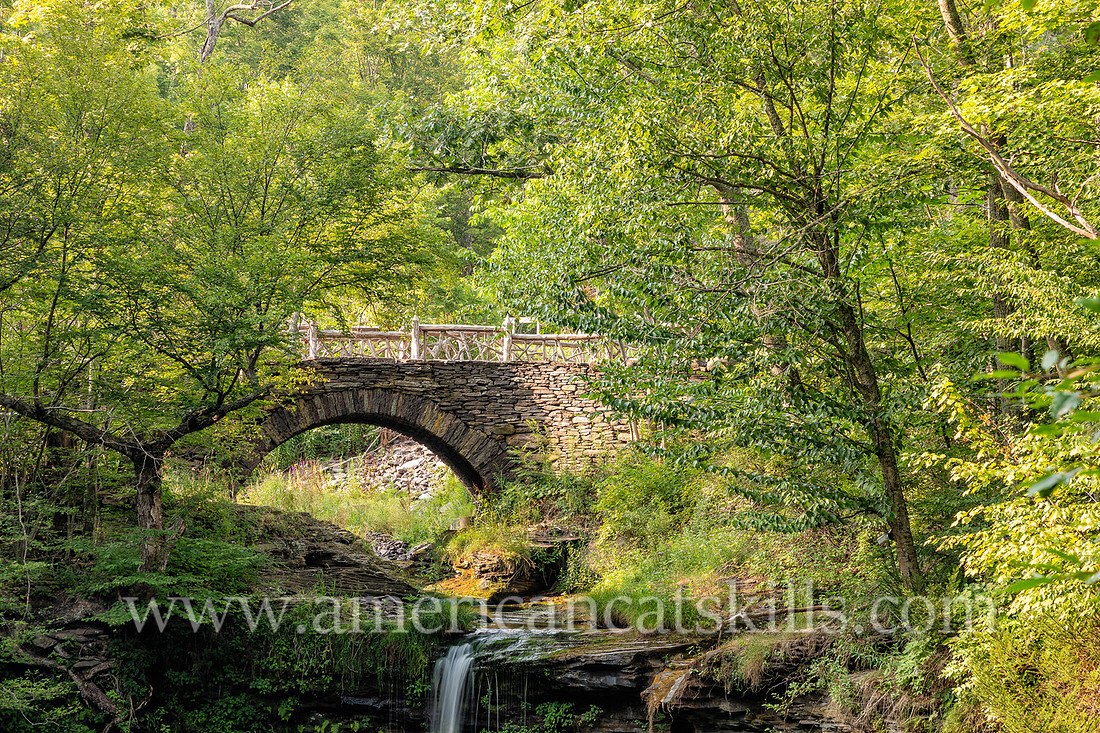
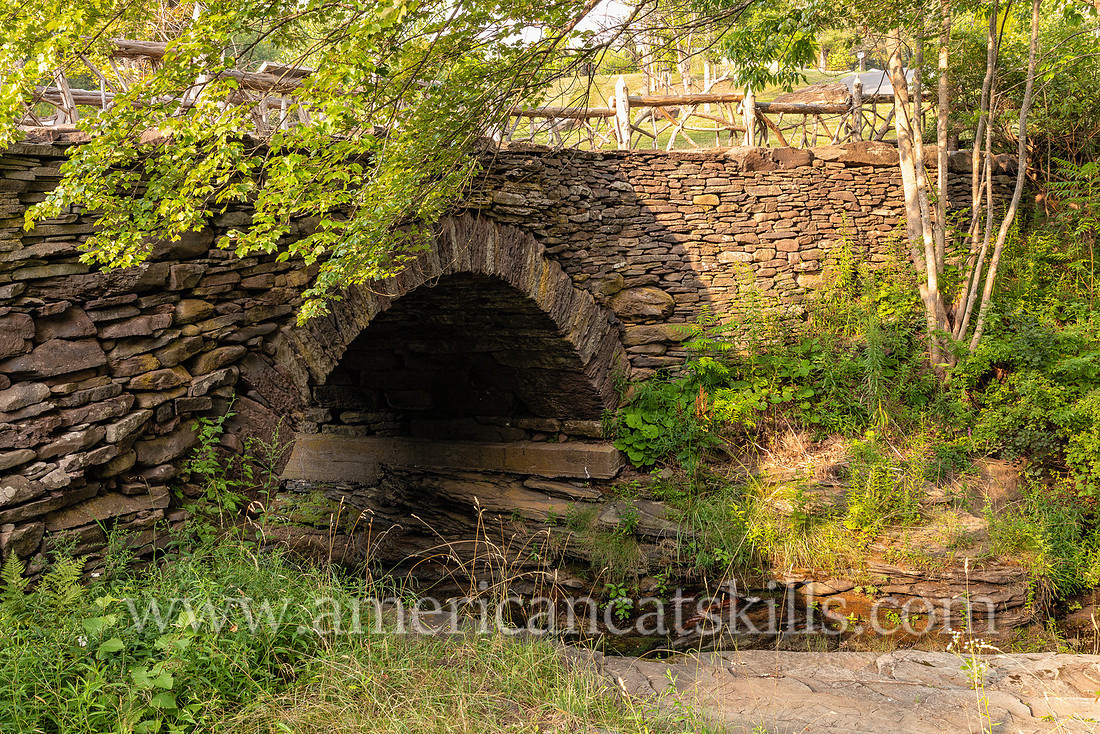
The stone arch bridge near the top of Stratton Falls was constructed by Willis Hubbell, a well-known local contractor. In addition to the bridge, Hubbell also constructed a bridge at South Kortright and built many early Roxbury houses. The Hubbell’s were a noted pioneer family in the region for whom two local areas were named, Hubbell Hill and Hubbell Corners.
During the 1800s, the hamlet of Stratton Falls was a thriving small community with several businesses that operated near the stone arch bridge at the top of Stratton Falls, including a distillery, cooper and blacksmith shops, a tavern, a general store, a creamery and a post office. The general store, operated by the Stratton and Hicks families, sold everything that nineteenth century residents might want.
Ira Hicks owned the popular general store at Stratton Falls while also operating a firkin factory next to his other stores. A firkin is a small cask which resembles a whiskey or wine barrel and for centuries it is what was used to store butter. For over 100 years, Delaware County was one of the leading producers of dairy products for New York City and there was a big “dairy trade” of products being transported from this area to the city. Ira Hicks profited from not only making and selling the barrels, but also from charging a fee to arrange for the transport of the farmers' butter products in the firkins to New York City. In 1848, Hicks constructed the mansion that is now the focal point of the resort The Roxbury at Stratton Falls.
Located nearby to Stratton Falls is the Second Old School Baptist Church of Roxbury, which opened for its first services in 1833. The church is listed on the National Register of Historic Places.
The settlement that grew up around the falls was at one time large enough to warrant a post office. The Stratton’s Falls post office operated from 1840 to 1876. Ezra W. Stratton, son of pioneer Joseph Stratton, was the first postmaster, serving for nearly four years from 1840 to 1844. The post office was discontinued on November 15, 1876 after 36 years of service.
The Rondout and Oswego, later renamed to the New York, Kingston and Syracuse Railroad and then the Ulster and Delaware Railroad, reached the town of Roxbury in December 1871. The line originally stopped south of the village in Stratton Falls but in 1872 it had been extended to Roxbury and then on to Stamford. The location of the station moved the business section of Roxbury from upper Main Street to Bridge Street and the current village square. Passenger service ended in Roxbury in 1954 and freight trains ceased running in 1976.
The oldest cemetery in the town of Roxbury is believed to be what is known as the Tyler Cemetery, located about a 1/4 mile south of Stratton Falls. The oldest stone in the cemetery dates from 1812 and marks the grave of Joseph Stratton, Jr., son of Joseph Stratton, the pioneer, who is also buried here. Members of the Tyler, Butler, Chase, Hull and Olmstead families are also buried here.
Jay Gould: A Native Son
Jason “Jay” Gould (1836-1892), the controversial American railroad magnate and financial speculator, was born at the family homestead in Stratton Falls on May 27, 1836, the son of John Burr Gould and Mary (More) Gould. His father was a farmer and a storekeeper. Jay was educated in the district school and at Beechwood and Hobart seminaries.
Having no interest in following his father’s footsteps, Gould went to work at age 12 as a clerk for a blacksmith in order to earn money to pay for school. After about six months of school, he then obtained a position at a tin-shop in Roxbury, and after three years, at age 15, he became a partner in the management of that business. Gould’s father later joined the operation and eventually took charge there.
During these years Gould privately taught himself mathematics, civil engineering and surveying, and obtained a position from his studies to work on a job mapping Ulster County, New York, earning an extra dollar on the side for every house on which he made a “noon mark” from which the occupants could accurately keep time.
Between 1853 and 1856, Gould surveyed and mapped the counties of Albany, Sullivan and Delaware, and the town of Cohoes. He was also in charge of the mapping counties in Ohio and Michigan, and the survey of a railroad from Newburg to Syracuse and of the Albany and Niskayuna plank road.
While engaged in surveying field work in Delaware County, Gould gathered materials from local residents on the history of the county. In 1856, at only 20 years of age, Gould published his History of Delaware County and Border Wars of New York along with his own comprehensive Map of Delaware County, New York, which was based on an actual survey that he had completed himself.
Soon after publishing the map and book, Gould moved on to larger enterprises. Around 1856, in eastern Pennsylvania, he established a tannery in partnership with Zadock Pratt, the famous Catskills tanner and founder of Prattsville, New York. At its peak, the operation employed 250 men and manufactured 1.5 million pounds of sole leather annually. That tannery operation would grow to become the village of Gouldsboro, Pennsylvania. Gould eventually bought out Pratt’s share of the operation, and joined in partnership with Charles Leupp.
Gould then left for New York City and soon began speculating in the securities of small railroads. Over the next several decades, Gould, through a variety of investments, and often unscrupulous actions, would go on to great financial success. He owned, at various times, the Western Union Telegraph Company, the Missouri Pacific Railroad and the Union Pacific Railroad.
Jay Gould is generally identified as one of the most corrupt and ruthless robber barons of the Gilded Age.
John Burroughs at Stratton Falls
John Burroughs (1837-1921), the famous author and naturalist, was born and raised in the town of Roxbury, only a couple of miles from Stratton Falls.
Burroughs would grow from his humble roots to author 27 books that sold over 1 1/2 million copies, as well as writing numerous magazine essays. Burroughs’ most popular writings became generally known as the nature essay.
The nature essay relied on Burroughs’ astute observation of his natural surroundings. He took long walks in the woods, collected plant and animal specimens and read voraciously about nature. He would often write not about faraway places that few readers would ever see but about his immediate surroundings. Subjects would include flowers, trees, birds, country living, open fields, barns and barnyards and farm animals. He would write about long hiking trips and fly-fishing. Readers could individually relate to the subjects and his essays resonated with wide audiences.
His literary prominence brought him the audience of John Muir, Walt Whitman, Thomas Edison, Henry Ford and even President Theodore Roosevelt. While his fame has diminished over the past century since his death, his contribution to the literary arts and environmental conservation has ensured that his legacy will not be forgotten.
While growing up, John and his friends would often visit Stratton Falls to go swimming and to collect slate from which they would make into pencils for school.
In his later years, Burroughs offered his recollections of his youthful days at Stratton Falls. “Now and then we school children would play hooky and make a trip down to Stratton Falls, a mile and a half distant, after slate to use in making slate-pencils. It was a place where there were high ledges, and a horseshoe fall of water that you could get in behind, and we liked to hang around there and play. We would run away at noon and not get back until long after school had begun. Our excuse was that we had to get slate-pencils. It was a great adventure. Streaks of slate cropped out in the ledges and we used to get little slabs of that slate and carry them home. Some of it was red and some blue. The way to tell if the slate would do for pencils was to rub it across the ends of your under teeth. You knew instantly by the grit if it was too hard or too soft.
We took the little slabs of slate home, and in our spare time would work them into slate-pencils. I’d cut with my knife two straight deep gashes on one side about a quarter of an inch apart, drawing the knife back and forth and back and forth by the hour. Then I’d turn the slab over and start other cuts to meet the first ones. By and by you broke off the slab along the gashes, and then you could whittle your piece into shape. We got all our slate-pencils in that way. You couldn’t buy them at the store. I never hear of such a thing as buying slate-pencils when I was a boy.” (Johnson, 65-66.)
Clara Barrus, author of John Burroughs: Boy and Man, offered some additional insights about John’s school-age days at Stratton Falls. “The noon-mark cut in the window-sill of the old schoolhouse was a pint of daily interest to the boys. Watching when the sun got there, they grew exceedingly restive if the teacher did not dismiss school on the instant.
Sometimes the boys went down to Stratton Falls for their nooning, bathing in the creek under the rocks. It was a long way off, and occasionally they decided that since they would be tardy anyhow, they might as well stay all the afternoon and get material for slate pencils. Loitering there in the deep gorge worn in the shaly rocks, they hunted out the soft green streaks in the red sandstone, first testing them on their teeth to make sure they would not scratch their slates! They saved these up till winter, whittling them out into pencils in the long evenings before the fire.
Some boys became very deft at pencil-making. It was quite a trick to get a good-sized piece, nicely whittled, without breaking it, and a boy who could do it extra well was the envy of the whole school. The best pencils were used as barter. John always envied one boy an especially fine long pencil with its shining-copper gun-cap. He was never able to swap his pocket treasures for it, and when his hair was white with age, he confessed that he had seldom coveted anything in life as he did that slate pencil of Hi Bouton’s.” (Barrus, 135-146.)
Stratton Falls Today
Stratton Falls is now part of the property at The Roxbury at Stratton Falls, owned by partners Gregory Henderson and Joseph Massa. The hotel has been featured on the national news and has won numerous awards for its whimsical elegance and themed rooms, as well as having been featured on the TLC, HGTV and Animal Planet networks.
One of the rooms in the renovated mansion house is named The Brothers Stratton, in homage to both Joseph and Samuel Stratton.
The resort grounds include scenic trails that lead to the bottom of the falls and to an overlook where you can view both the falls and the historic stone arch bridge.
Visit The Roxbury at Stratton Falls website at www.theroxburyexperience.com for more information.
Selected Sources:
Barrus, Clara. John Burroughs: Boy and Man. Garden City, New York: Doubleday, Page & Company, 1922.
Biographical review: This Volume Contains Biographical Sketches of the Leading Citizens of Delaware County, New York. Boston: Biographical Review Publishing Company, 1895.
Halstead, Murat; J. Frank Beale, Jr. Life of Jay Gould: How He Made His Millions. New York: Edgewood Publishing Company, 1892.
“Historic Roxbury Land Sold.” Oneonta Star. June 22, 1964.
Johnson, Clifton. John Burroughs Talks: His Reminiscences and Comments. Boston and New York: Houghton Mifflin Company, 1922.
Stratton, Harriet Russell. A Book of Strattons. Volume 2. New York: Frederick H. Hitchcock, 1918.
The Roxbury Experience. www.theroxburyexperience.com.
