
Spruceton Methodist Church
Introduction and Location
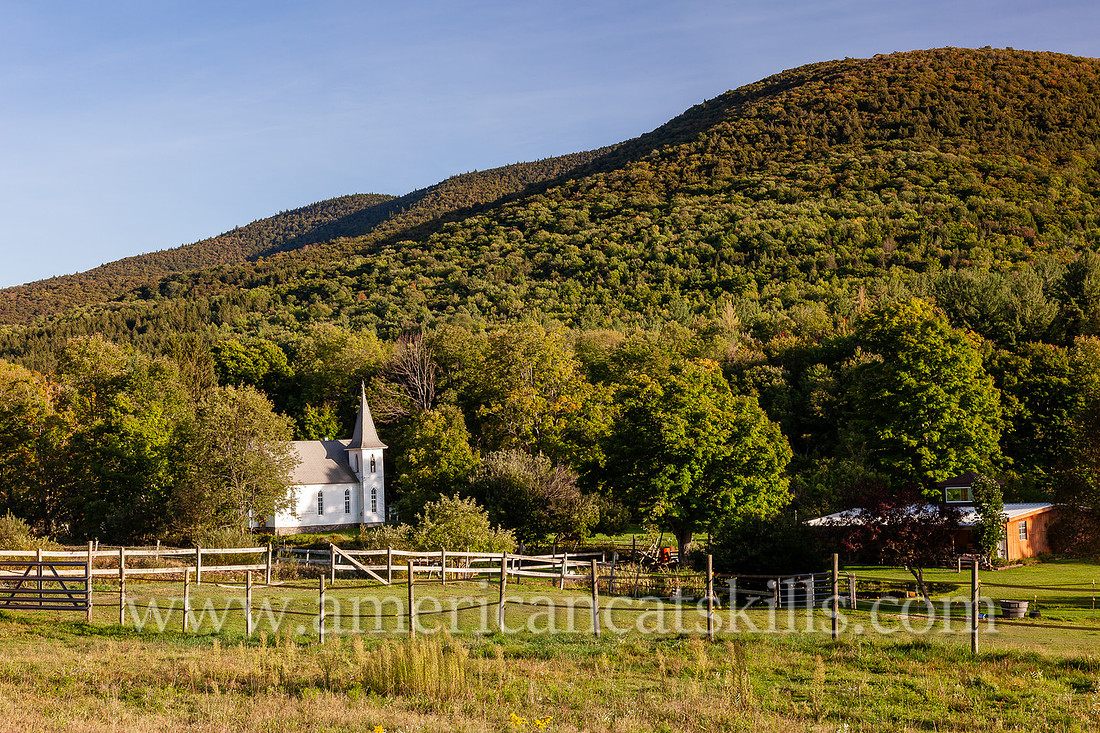
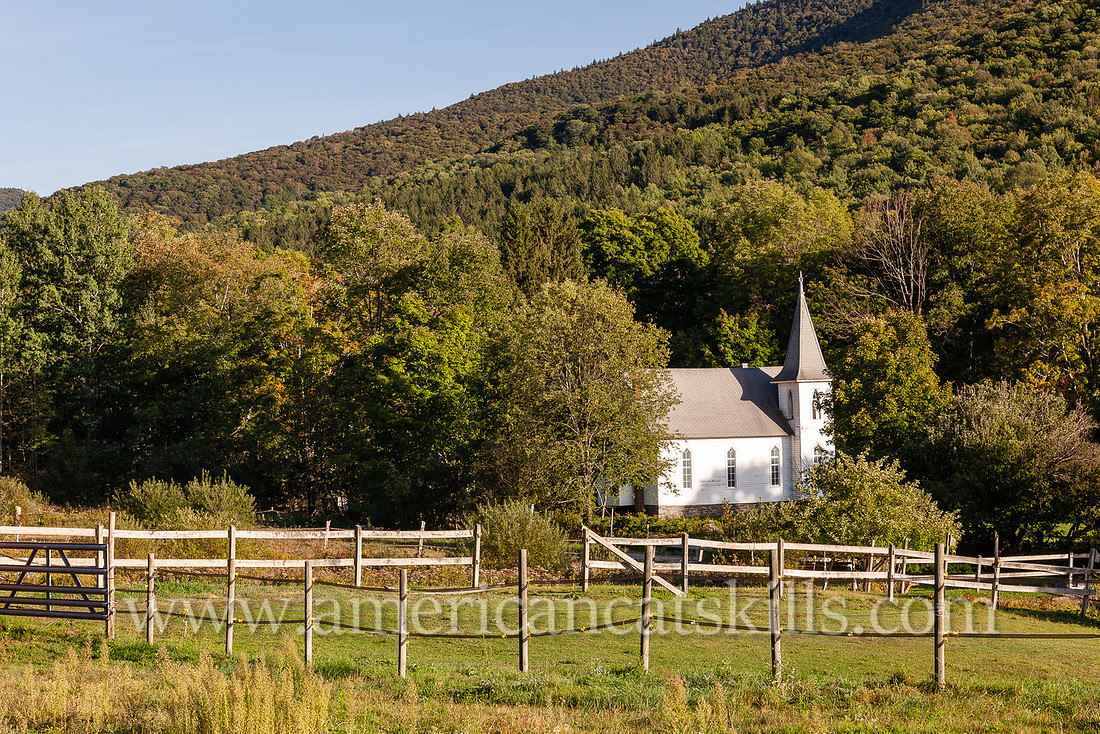
Spruceton Methodist Church is located in the long and winding Spruceton Valley. The small hamlet of Spruceton is located within the town of Lexington in Greene County, New York.
Spruceton Road begins at the hamlet of West Kill and ends at the trailhead parking areas for Hunter Mountain and Diamond Notch Falls. The road and the valley generally follow the West Kill and are surrounded by high mountain peaks like Pine Island Mountain, Evergreen Mountain, Rusk Mountain, Balsam Mountain, Mount Sherrill, North Dome, St. Anne’s Peak and West Kill Mountain.
The 11-mile-long West Kill forms between Hunter Mountain and Westkill Mountain, flows through the Spruceton Valley and past the hamlets of Spruceton and West Kill before joining the Schoharie Creek at the hamlet of Lexington. The beautiful 25-foot Diamond Notch Falls is located on the West Kill at the end of Spruceton Valley in the Westkill Mountain Wilderness Area. Herdman Brook joins the West Kill just west of the church.

The Spruceton Name
Spruceton was named for the numerous red spruce trees in the area. According to Michael Kudish in his book titled The Catskill Forest: A History, “the name of the hamlet of Spruceton does originate from the presence of this conifer in the valley of the West Kill. Most of the red spruce were and are today on the upper slopes and ridgecrests of Rusk and West Kill Mountains. West of these two peaks, no spruce was or is to be found along the ridges. In the West Kill Valley, spruce descended to about the hamlet of Spruceton and not any farther west. Most of the red spruce in the valley was logged off during the nineteenth century.”
The Hamlet of Spruceton
After the first settling of people in West Kill two men found their way into the valley now called Spruceton, and being impressed with the natural beauty of the place as well as the good pasture and hunting and fishing they cleared a little land. These two men, old Uncle Stephen Butler and William Dunham, were mighty hunters and at this time the Spruceton valley was a wilderness abounding in bear, deer, fox, and other game, with fur-bearing animals all circling the beautiful falls that is still the center of beauty of this entire section. (“Old Spruceton Landmark Sold.” Stamford Mirror-Recorder. July 2, 1930.)
William Dunham married and had a son by the name of Aaron Dunham who bought what would become the Dunham homestead from the Old Uncle Riley land. Aaron finished clearing the land and set up in the dairy business along with the raising of sheep. Aaron married and they had a fine family of twelve children and, with property also bought of Stephen Dunham, built a fine home. In those days they were mighty hunters and were able to withstand the ravages of bear, wild cat and wolf. One of the children of Aaron Dunbam, Elmer E. Dunham, remained on the farm continuing in the dairy and sheep business, making a fine success.
Over the years, particularly in the late 1800s and the early 1900s, the hamlet of Spruceton was home to many popular boarding houses, including the Mountain Retreat Home operated by Wesley Van Valkenburgh, the Maple Grove House operated by George Van Valkenburgh, the Maple Avenue House operated by Charles Dunham, the Spruceton House operated by W. M. Dunham and the Diamond Notch House operated by Henry Van Valkenburgh.
The Spruceton Post Office was established on September 16, 1879 and operated for 78 years until its closing on September 15, 1957.
Clarence Vredenberg of Spruceton, New York wrote to the local newspaper saying “the way people have responded in improving the Spruceton cemetery has inspired me to try to write a few lines to show the real affection we have in our hearts for this beautiful valley.” Vredenburg then provided his own personal poem titled Spruceton.
“Memories of old Spruceton
Linger with me day by day,
No matter where I go, no matter come what may,
Love for it is in my heart to stay.
I was born in its mystic splendor
And grew up in its quiet woods,
Where the heart will oft grow tender
With its wondrous, changing moods.
And there in the little school house
At the foot of the steep side slope,
We learned from books and others
That in life we must work and hope.
‘Twas there I learned to love her
‘Twas there she loved me, too;
And our life together has been
Blessed, full and true.
And there our children joined u
To make our joys complete,
For there’s nothing on earth to brighten a home
Like the sound of little feet.
And when they in turn were sent to school
To prepare for the journey through life
We knew the health they’d acquired in the vale
Would keep them through inevitable strife.
When I no long can see this valley
That to me is so sweet and fair,
I pray that they will understand
And let me sleep forever there.”
Spruceton Methodist Church
The Spruceton Methodist Church was constructed in 1889 at a cost of 1,800. In June 1889 it was reported in the local newspaper that “carpenters are at work building a Methodist Church at Spruceton.” (Daily Freeman. June 16, 1889.) In August 1889, a series or “festivals” were held to raise money for the purchase of a bell for the new church. It was reported that $22.18 was raised for the cause. (Catskill Recorder. August 23, 1889.)
The church was dedicated on Thursday, October 10, 1889 “to the great joy of our people in those places, who up to that time had been deprived of sanctuary accommodations of their own.”
A similarly-styled church was constructed at about the same time at the head of the valley at West Kill at a cost of $2,500. The Westkill church was dedicated two weeks after the Spruceton church on October 24, 1889.
By December 1889, the Spruceton congregation was looking to raise money to pay off some of the debts incurred in constructing the church. In response, “a noted damsel, of Spruceton, offers to kiss any man for the small sum of five cents, the money to go towards paying the church’s indebtedness.” (Columbia Republican. December 12, 1889.) It is unclear how much money was raised with this novel fundraising effort.
The Spruceton Methodist Church building offers “classic” regional church architecture – simple yet elegant. The glimmering white paint, raised-to-the-heavens bell tower, uncomplicated framework, and open field and mountain backdrop, making this an ideal place for reflection. The church is wonderfully isolated on a dead-end country road, evoking thoughts of quieter times when it would have been a community gathering place for Spruceton Valley residents.
On June 29, 1941, nearly 54 years after its founding, the Spruceton Methodist Church held an “Old Home” service, in which former residents, families and friends were invited back to the valley for a reunion to be held at the church. The Windham Journal described the history of the church and the events leading up to the “Old Home” service.
“When traveling from Lexington to Shandaken and passing the cozy little village of Westkill nestled at the approach of the deep Shandaken Notch, one of the wonders of the Catskills, a stranger would hardly realize that should he pass through this village that there was a pleasant and fertile valley winding up between these two high ranges of mountains for more than eight miles and with good roads. It affords pleasure for the people who come to the mountains in summer for vacation and others who come to fish and hunt. In the midst of these pleasures to some, disappointment, sorrow and heartache have crept in because of tragedy lurking near.
At the end of this Spruceton valley is a trail leading directly over the mountain to Lanesville. For some years a boys' camp has been maintained near the beginning of this trail and now the Boy Scouts Camp Half Moon which was located in Cairo has been moved near this trail.
In former years all the farms from Westkill to the "head" of Spruceton were occupied by families who toiled for pleasure and profit bringing up their children in an independent manner with, perchance in some instances, not too many luxuries but with good wholesome food, and getting their education and practical knowledge to make them good citizens and a credit to the community and fit them for the responsibilities of life, attended the little "red schoolhouse" developing their imagination in producing objects not at hand, while in the present day children from this valley must start for school very early in the morning and sometimes in the year not return until nearly dark at night because they must travel miles on a bus to a Central School with all modem equipment which shows the advancement in education the years have brought.
The people of this valley held religious services in this same little schoolhouse, this with Westkill being "out appointments” of the Lexington charge.
About 54 years ago, Rev. J. P. Carley who was serving the Lexington Pastorate did not think the schoolhouse adequate for services any longer and he conceived the idea of building a church and at once the plan took form and a site was obtained from the Wesley Van Valkenburgh farm and a church was built. As in many communities some of the families residing there at that time moved to other communities, the older faithful members passed on to their eternal home, some farms were abandoned and sold to the state, new people moved in, some who had other church affiliations and numbers to attend the little church seemed fewer each year but its doors were never closed and it has always stood as a Beacon of Light maintained through the years of discouragement, prosperity, and depression by the faithful few with the help of some very much interested and sincere newcomers in the neighborhood.
It would seem with so much selfishness, anxiety, hatred, greed and upheavals of every kind among the people of the world today that there are added attractions to lure the people away from the church and its activities everywhere but who would want to live in a town or bring up their children where there was no church to lend its influence for good? If this be true the people must press on and strive to maintain the high standards of the church and its purpose in every community by their presence and financial support.
Some few years ago the Lexington and Prattsville charges merged, with the pastor living in Prattsville and having Lexington, Westkill, Spruceton, Little Westkill at "out appointments." The Rev. M. E. Douglas who is pastor at the present time and has been for several years, has served this large area faithfully and well, never being afraid of lending a helping hand on renovating church property, substituting as organist, as well as preaching on Sundays and week days, or any other way he could help or do a kind deed.
Like all buildings become from time and use, this Spruceton church was in need of repairs but funds were scarce, so the pastor and people decided to put shoulders to the wheel and see what could be done. They scrubbed and painted, cleaned and turned the carpet, placed new linoleum across the back and when it was finished everyone felt so well repaid that someone remarked "Let's invite the former members and families and friends to an 'Old Home' Service."
No sooner said than done. Again, the faithful ones whose enthusiasm never wanes when good may come, set about sending invitations to those who had lived in Spruceton but were scattered far and near at the present time, to come to an Old Home Service at the church June 29, 1941 at 2:30 D. S. T. The outcome was, that although the weather was very warm and skies threatening, more than sixty people came to enjoy the fellowship and a social hour after the service renewing old acquaintances and making new ones.
The Church was nicely decorated with flowers, Rev. and Mrs. Douglas sang a duet very beautifully, after which the pastor presented a very inspiring sermon and thanked the people for coming to the service.
A table placed in the rear of the church was loaded with different kinds of delicious cake and fruit-ade which a committee passed after the service.
It was an inspiration to attend this meeting and several remarked it would be good to make this an annual get-together event.
Much credit is due the pastor and people for their work and this enjoyable service.” (“Spruceton Church Had “Old Home” Service.” The Windham Journal. July 10, 1941.)
In lasting testament to its long, distinguished history, the Spruceton Methodist Church continues with this “old home” tradition, opening its doors for one service each year, typically in August.
Reverend Joseph P. Carley
The Reverend Joseph P. Carley (1851-1919) was the first pastor at the Spruceton Methodist Church. He had a long and distinguished career in the church and was highly regarded in every community in which he preached and served. He passed away on March 28, 1919 and is buried at the Cooks Falls Cemetery in Cooks Falls, New York. The following obituary was published in the Republican Watchman newspaper in Monticello, New York.
“The Rev. Joseph P. Carley died very suddenly at his Cook's Falls home on Friday evening at 8 o'clock, from acute indigestion. Some of his neighbors though, seem to think that his death was due to a stroke. He had been very active during the winter and was apparently in his usual good health until noon on Friday. At two o'clock he laid down upon the lounge and gradually grew worse until he died.
The Wednesday before his death he wrote a cheery letter to a Monticello man, and closed the letter with - "I hope you are all well, and that God's richest blessings shall rest upon you all." That is a characteristic letter of a good man, made especially good by his services to his fellows.
Mr. Carley was born at Centerville, now Woodridge, about 68 years ago. He was the son of George Carley, a farmer of that neighborhood. As a young man he labored as a carpenter and farmer and was happy at his work. One day he woke up an unconscious thought - he must help save men - and as he sawed boards and drove nails in the days that followed that thought plagued him, until finally in desperation he laid down his hammer and saw and proceeded to proclaim the unestimable riches of God's goodness to such as would believe. That was many years ago - in fact some years before he was granted a conference relation. His first appointment was at Lexington in 1888, but prior to that date he had held a local preacher's license and had been appointed to various pastorates by the Presiding Elder or District Superintendent, as that functionary is now known. He served Lexington for two years and had one of the most successful pastorates of his ministry.
In '90-'91 he was at Gilboa; '92 at Oak Hill; '93 West Fulton; '94 at Bovina; '95, '96 and '97 at Stevensville; '98-'99 at East Branch; 1900-1 at Milton; '02-3-4-5-6-7 and 8 at Johnsville; 1909 at Charlotteville; '10 at Greenville; '11, '12, '13 and '14 at Bridgeville; '15 and '16 at Phillipsport and Wurtsboro; '17 and '18 at Cook's Falls, where he died. He was one of the best Bible students in the conference, and few men knew their Bible better than he.
Mr. Carley was sensible and earnest as a preacher. His sermons appealed to the reason rather than to the passion. He had a strong faith in God and in the sufficiency of the Gospel of Truth to save men, and with such a belief and such a mission his revivals were genuine and permanent. His nature was as gentle as a woman's and his sympathies repeatedly opened up the flood gates of his soul. How tenderly he administered the wants of the afflicted and the distressed; how affectionately he loved them into the Kingdom. He was one of the most beautiful characters that we have ever known. If the Bishop sent him to a poor charge he smilingly went and was happy. If he was sent to a better charge the succeeding year year he still smiled and was thrice happy. He took the appointments as they came, and with few exceptions they were poor enough. And yet, there were few men in the Conference more loved than he - genial, gentle, loveable Carley. How his friends will miss him in the days to come.
With all his gentleness he was a man of force and opinions. He was one of the strongest temperance advocates we ever knew and about all the trouble he ever had in his ministry was due to his outspoken denunciation of the liquor business. But notwithstanding his strong opposition to the business, he generally had the profound respect of the men who were in the business. Some them cursed him at his back, but they respected him enough to employ him to marry their sons and daughters and say the last sad rites over their dead.
In his younger days he worked for the late Harrison Osborn on his Centerville farm and he worked just as he preached, with vigor and success. He could cut more wood than any other man on the farm and apparently do it easier than anyone else. One of the Osborns says he knew him to cut four and one-half cords of block wood in a day - which was some wood chopping - and physically he was always in trim, even up to the day of his death.
Mr. Carley was twice married. His second wife, son Paul and daughter Nina survive. The daughter is a school teacher and the son is a school teacher-preacher. It is only a few weeks ago that he was taken from the school house at Shady and elevated to the ministry at Leeds and he is now preaching the same Gospel that his father preached. That was a happy day in the Carley home. Too bad that he couldn't have watched his son's progress in the ministry.
His funeral was held on Tuesday at Cook's Falls and the interment was in the Cook's Falls cemetery in the valley he loved so well and among the people he served so faithfully. Five of his brothers in the ministry officiated at the service, which was in charge of District Superintendent Rev. Dr. F. H. Deming. Rev. J. A. Hurn preached the funeral sermon; Rev. C. H. Basford made the prayer; Rev. L. Terwilliger and Rev. M. B. Tanner read the scripture.
It was a sad parting. A noble life had gone out.” (“Death of the Rev. Joseph P. Carley.” Republican Watchman. April 4, 1919.)
Spruceton Methodist Church Cemetery
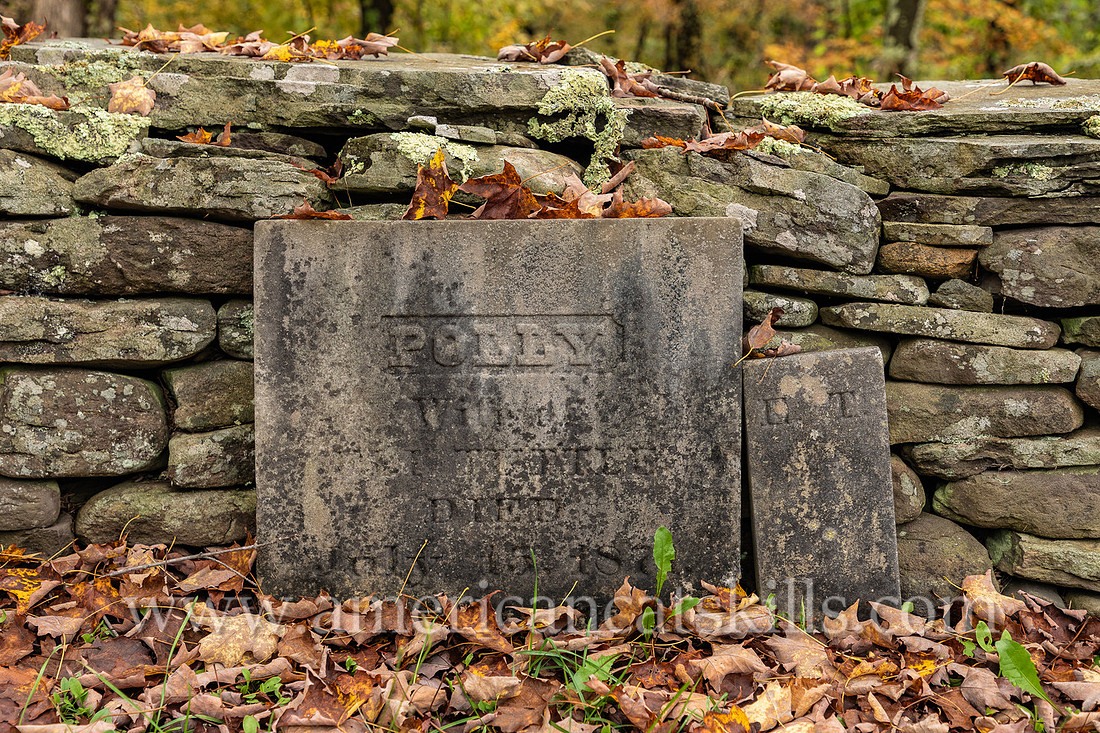
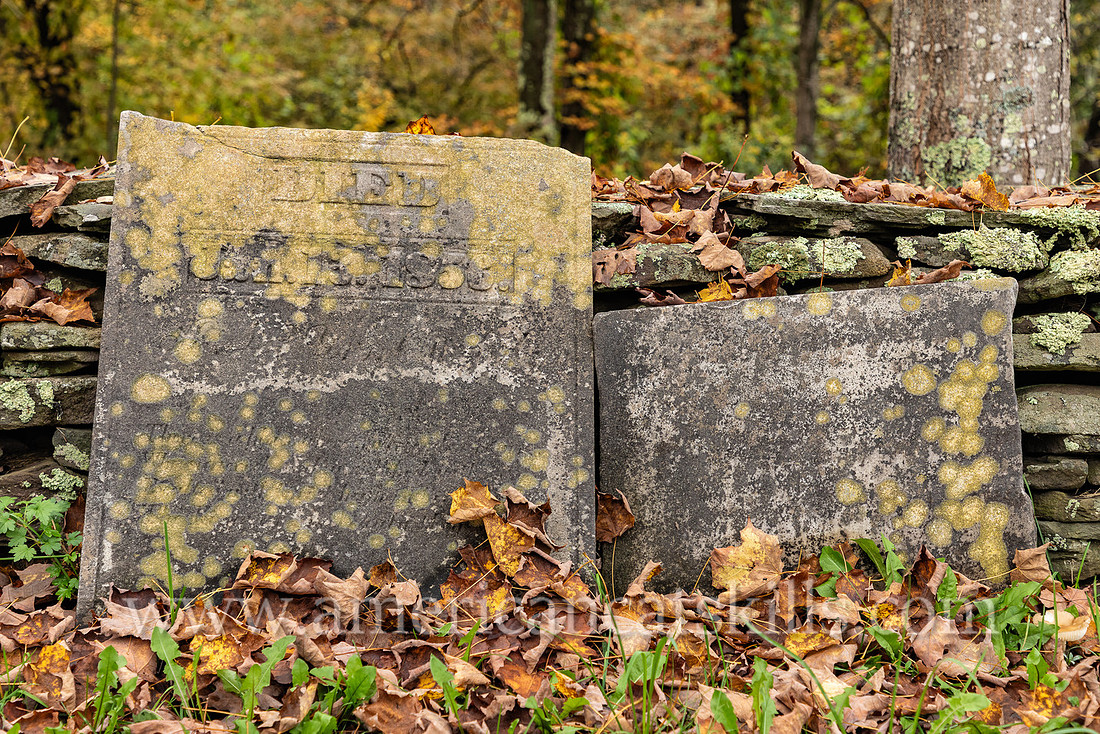
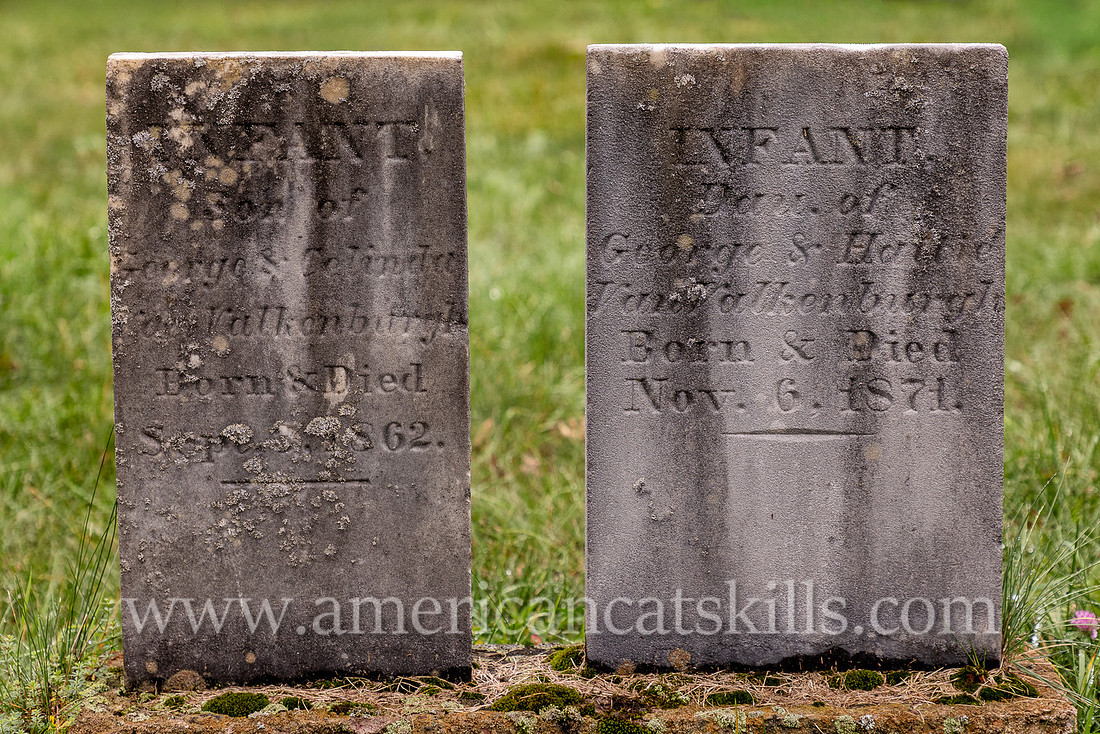
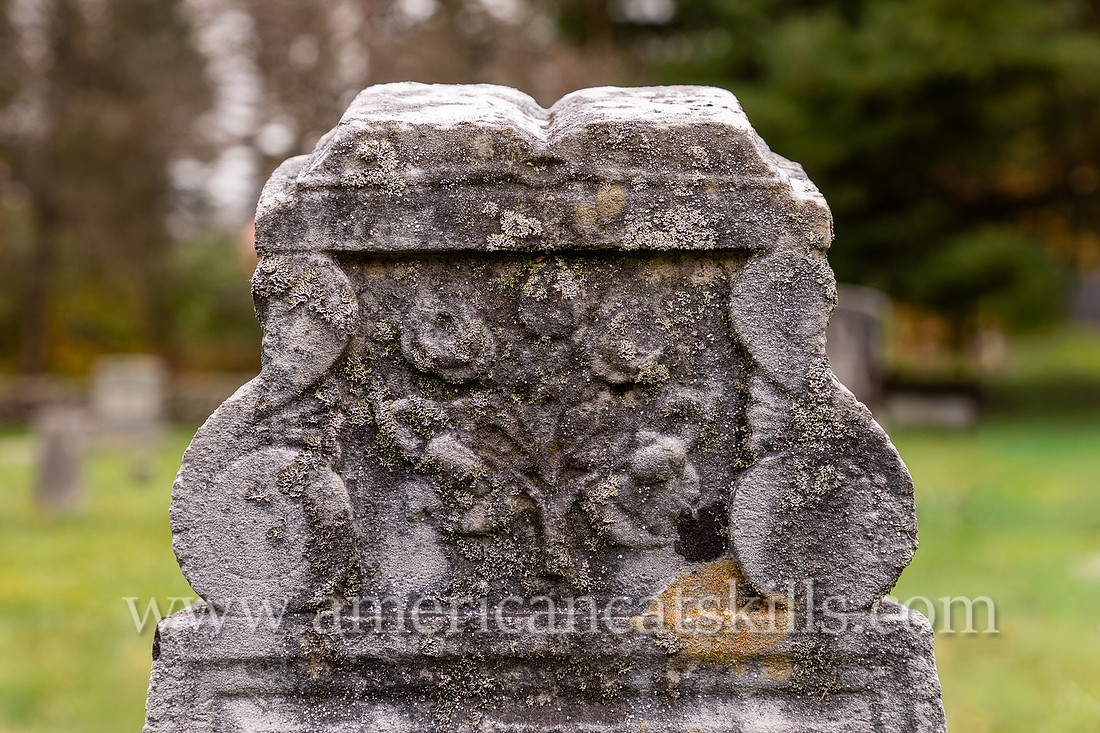
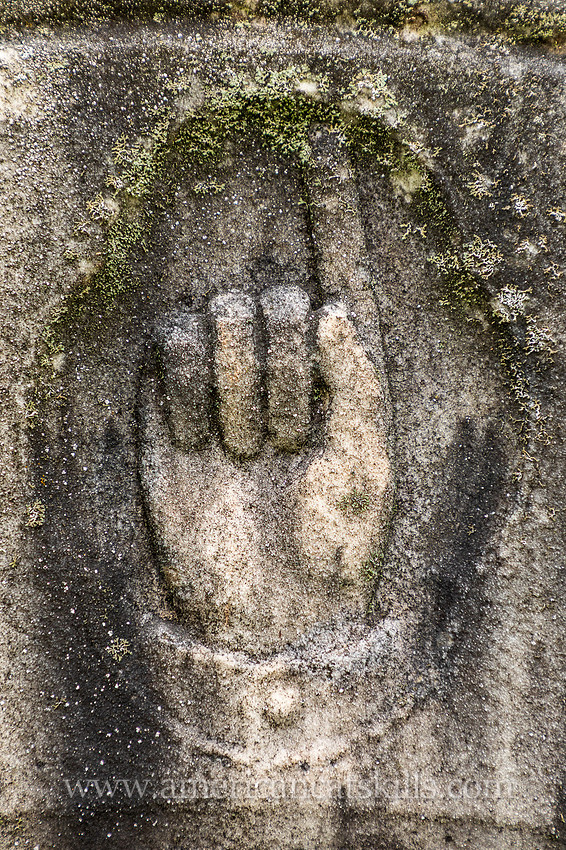
The Spruceton Methodist Church is adjoined by a small cemetery. There are many gravestones representing the Van Valkenburgh family, one of the earliest and most influential families to settle in the area. Other prominent family names found at the cemetery includes Black, Bonesteel, Dunham and Kirk. Gravestones date from between the mid-19th century through the 20th century. The cemetery is surrounded by a classic stone wall and accessed through a decorative iron gate.
Directions
From the intersection of Route 42 and Route 6 at West Kill, take Route 6 east, and drive for approximately 4.8 miles. The Spruceton Methodist Church will be on your left. Park anyplace on the side of the road.
