
Wynkoop House, Saugerties, New York
Introduction
The historic Wynkoop House is located on the west side of the Old Kings Highway (now NYS Route 32), in the Town of Saugerties, Ulster County. It is less than a 1/2 mile north of NYS Route 212, which connects the villages of Saugerties and Woodstock.
The New York State Thruway (Interstate 87) parallels Route 32 immediately to the east and is visible and audible from the house. The Thruway exits on to Route 32 just south of the house. A Holiday Inn Express hotel is located directly to the west of the house.

History
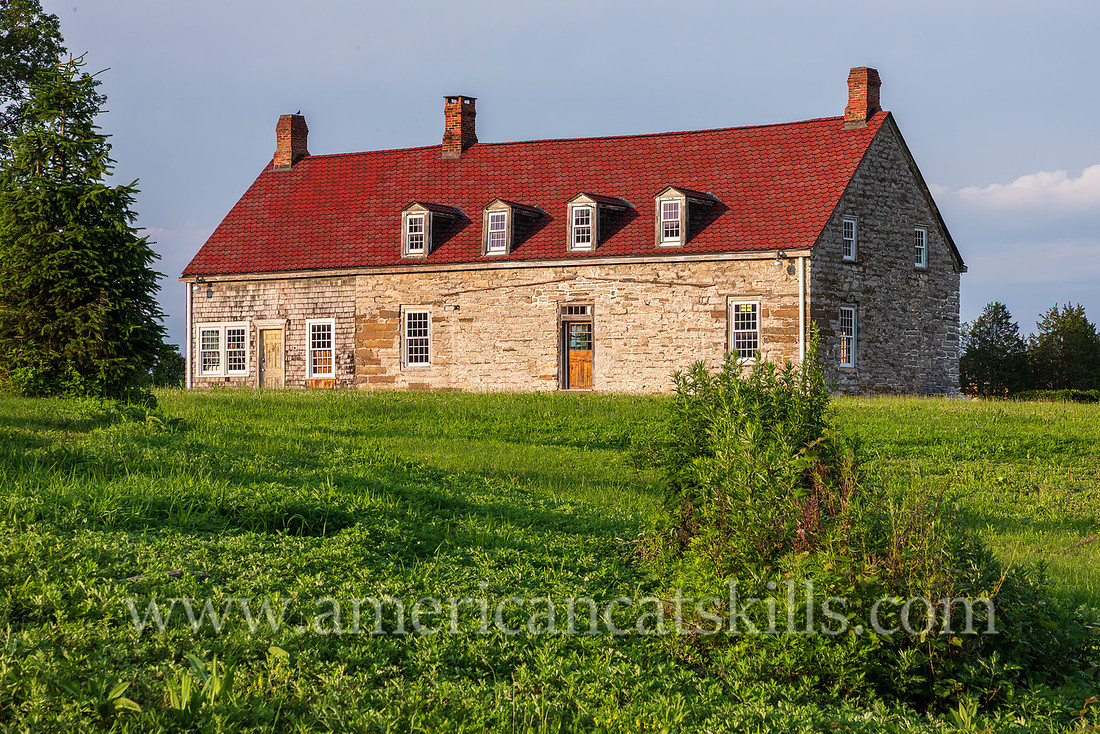
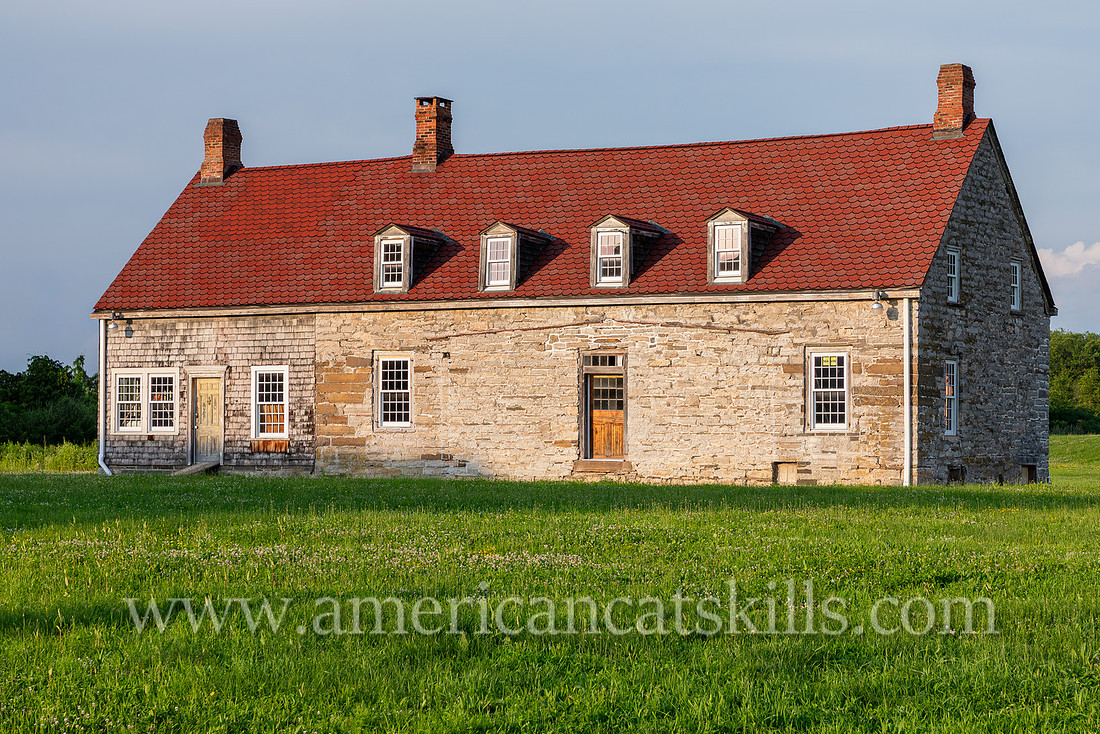
The Wynkoop House was built in two sections, with the original one-room plan dating to circa 1740, and a later two-room, center-hall plan representative of buildings constructed between 1750 and 1775 in the region.
A map of Saugerties drawn by J. E. Van Alen in 1763 which locates a dwelling on the site establishes the earliest documented date for the property.
The house was erected on a tract of land originally part of a patent granted in 1688 by James II to Richard Hays and George Mealls. According to the National Register of Historic Places, exactly which descendant erected the Wynkoop House is not clear; however, local tradition places the family in this location. Unlike many Ulster County stone houses, the Wynkoop House does not contain a marker carved with the initials of the builder.
However, David Baker, the town of Hurley historian, as more information became available, offered new and differing information in 2004, over 20 years after the Wynkoop House was first placed on the National Register of Historic Places. Baker has stated that “the original owner of the building was Johannes Wynkoop, son of Evert Wynkoop of Saugerties.” Johannes had married Catherine Schut, a local woman, before the couple temporarily moved to the Hackensack/Paramus, New Jersey area where he was active in the creation of the Dutch Reformed Church of Paramus. Johannes and Catherine returned to the Saugerties area in 1738 and two years later he built the house that now bears his name. The home was eventually passed to Johannes’ son, Evert, who was later responsible for the renovations to the building.
Baker has also stated “the original owner of the building placed a date stone on the front of the building, giving his initials, in this case his monogram, and the year the house was finished. The date stone is found high up on the original front wall between the left window and the door; a typical placement for the time.” His monogram “J” is followed by a wine glass or chalice; likely in reference to they Wynkoop name, which is a combination of two Germanic words, “wine” and “container.” (Cahill, Katie. “Ye Old Coffeehouse.” Saugerties Times. May 20, 20024.)
The original one-room stone house appears to have been the customary form chosen for permanent housing by settlers in the county from the initial settlement in the seventeenth century through the expansion of the Colonial period. To that basic structure was added, at some later time, a larger two-room structure with a center passage this structure also represents a distinct regional residential form which can be termed the second generation of the Dutch house type. This form persisted through the Federal period.
The 1 1/2 story rectangular stone residence was constructed from local quarried limestone with random decorative bluestone and rubble-filled walls. Masonic emblems are cut in the stone over both front doors, indicating a meeting place. A date stone reading “1740” is located near the high up on the original front wall between the left window and the door.
The Kings Highway originally passed to the west of the house and was re-routed east of the house at some later date. Therefore, what was originally considered the front of the building is now considered the back of the building. Eventually, the building was remodeled to face the new road.
The house was home to Schoentag’s Colonial Tavern from the 1930s to the 1960s.
The Wynkoop House was once part of the famous Winston Farm, which is perhaps best known for hosting the Woodstock ’94 music festival, held in August 1994 to commemorate the 25th anniversary of the original historic music festival that attracted more than 500,000 fans.
Wynkoop Family
The Wynkoop family was established in Ulster County with the arrival of Cornelius Wynkoop c.1667 in Hurley, about fifteen miles south of Saugerties, near Kingston. The family expanded and Wynkoop's descendants had established themselves in Saugerties by the mid-eighteenth century.
The Wynkoops played an active role in the Revolutionary War and local politics in the nineteenth-century. Descendants occupied the house until the early twentieth-century which may have contributed to its remarkable preservation.
Saved From Demolition
In 2002, Ronald Robins purchased the Wynkoop House and the surrounding property for $140,000 with the intention of tearing the house down and replacing it with an office building. Robins’ plans for the property and the threat of demolition triggered a wide community response and a significant change in the attitude of town government towards historic preservation issues. In response, the town placed a stop work-order on it and put a 9-month moratorium on issuing building or demolition permits.
By June 2003 the town was considering purchasing the home from Robins, but the significantly increased asking price of $695,000 was too much. Eventually, Mark Colligan, a chiropractor, and his wife Wendy Ricks, a real estate attorney and a town of Saugerties justice, stepped in to purchase the house and saved it from demolition. Colligan and Ricks planned on restoring the building as a coffee, ice cream and internet café. Soon after purchase, Colligan and Ricks went to work, stabilizing the structure and repairing the dilapidated roof.
It is unclear if the café was ever opened and by 2013 the Wynkoop House was back on the market for $750,000.
National Register of Historic Places
The Wynkoop House is listed on the National Register of Historic Places as “as an outstanding example of eighteenth century stone vernacular architecture in the Hudson Valley . . . [and] exemplifies a traditional regional practice of staged expansion from a single room plan settlement house to a multi-room, linear plan residence. The association the house shares with the Wynkoop family provides a documented link between the house type and the ethnic Dutch cultural heritage in the area.”
