
Plymouth Church, Walton, New York
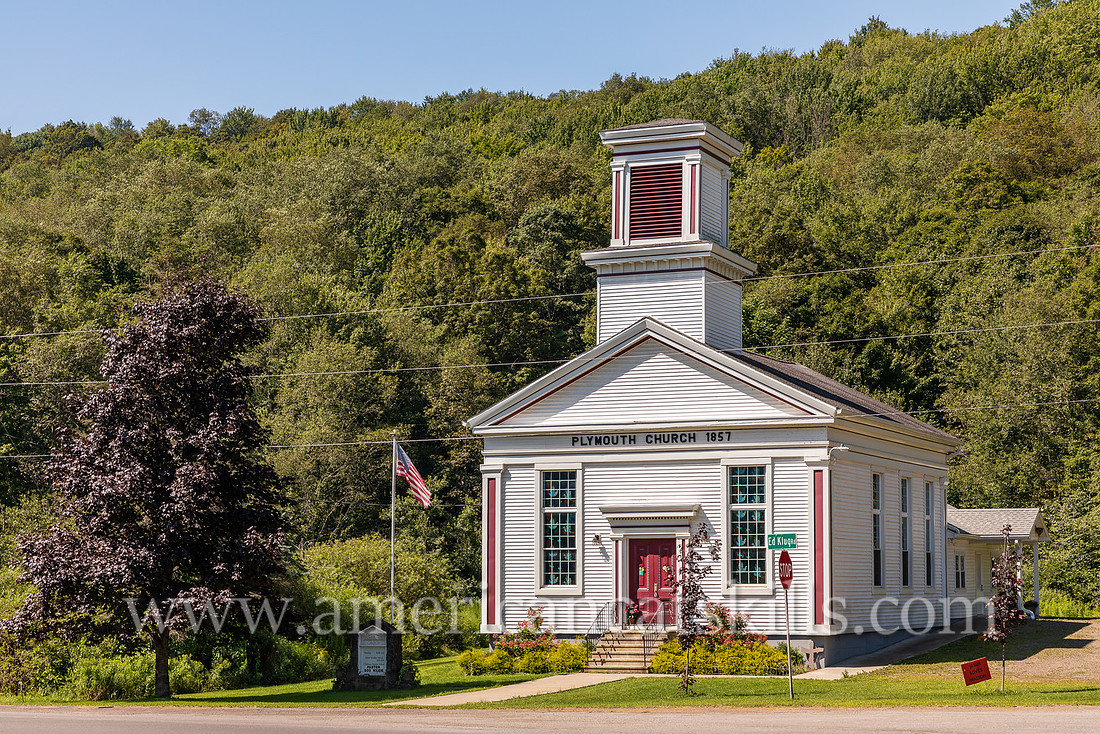
The historic Plymouth Church is located along Route 21 (Franklin-Walton Road), north of the village of Walton. It is situated on the West Brook, a tributary of the West Branch of the Delaware River.
The church has long supplied the religious needs of a large farming community that was situated several miles from the nearest village. In its earliest days, the nearest churches at Walton, Northfield and Franklin were from four to six miles distant and, therefore, many could not attend service.

The Founding of Plymouth Church
The church congregation was established in 1857 by “a small but earnest band of men and women” who “gathered in the West Brook schoolhouse for the purpose of forming a church.” During this meeting, the Plymouth Congregational Church of West Brook was founded.
The church building was constructed over the course of the next year. Construction began on June 10, 1858, the timbers for the frame of the church were raised in July 1858 and construction was completed in November 1858.
George Nichols donated the site for the building. Thomas Nichols gave the timber for the frame and all the neighbors for three miles around cut the timber, drew and scored it without charge. D. Wiswall, S. Polton, J. D. and Mike Seeley built the church.
At 11am on Thursday, December 23, 1858, the church was “dedicated for purposes of public worship.” The first sermon was preached by Reverend S. P. Martin of Franklin. In its early days, the church was often supplied with ministers from North Walton.
The church was organized with ten charter members, including Chester Pomeroy, Isaac McClenon, James M. Benton, Simeon A. Freer, Phoebe Pomeroy, Deborah McClenon, Angeline Brazee, Caroline Freer, Mary Ann Pomeroy and Helen Freer. Chester Pomeroy was chosen deacon and Isaac McClenon was chosen clerk.
Early Years
Only a few years after its founding, and likely due to its remote location, the Plymouth Church already began to struggle with membership and the ability to retain a permanent pastor. In 1862, it was reported that “Rev. C. S. Marvin has closed his labors with the Plymouth Church at West Brook, where he has been very useful, and is highly esteemed. That church and society are hardly able to sustain a minister, without considerable help from other quarters, more we fear than they will be likely to get in these war times.” (Delaware Republican. April 12, 1862.)
50th Anniversary of Plymouth Church
On December 22-23, 1908, the church celebrated its 50th anniversary with special services over the course of two days. The church was led at this time by Reverend W. C. Davies.
The local newspaper wrote of the special occasion: “This is a country church in a comparatively sparsely settled community and could draw for its membership only a few miles in each direction, but while it has had its times of prosperity and adversity, like all churches, it has continued to grow and now counts a membership of forty.” (“Plymouth’s Anniversary.” Walton Reporter. December 26, 1908.)
Back to Life
By 1955, Plymouth Church had been largely abandoned for over 15 years. That same year “the Rev. Richard Moore, a Franklin minister, with his family, would pass the old church on their frequent visits to relatives.
“There’s the old broken down church,” Mr. Moore would remark, and Jimmy, his small son, would always answer, “Somebody will fix it some day.” This thought turned over and over in Mr. Moore’s mind – he could visualize how it could look were it repaired. People in general felt sorry to see it go down. He liked serving churches in rural communities, as did his father before him.
The Youth Fellowship of Mr. Moore’s church in Franklin wanted a project and the news was passed around that they had decided to clean up the old place and at least hold one service there. So Resurrection Day for Plymouth Church finally came. . .
Young people came, neighbors came, passerby even stepped to lend a hand. Many a pot of coffee helped in its own small way.
Weeds, brushes and trees were cut down. Dirt, stones and glass by the wheelbarrow load was taken out of the church. It was not before they began to see the fruit of their labors.” (Oneonta Star. September 29, 1956.)
The church was reopened for worship on June 12, 1955. Reverend Moore preached the sermon and there was special music provided by the junior choir of the Franklin Methodist Church, who were accompanied by several trumpeters. Though it no assigned pastor, Hartwick College of Oneonta helped to supply it with student ministers.
After that first service, the renovations continued. A new roof was put on, all the broken windows were replaced and the building was placed on jacks so that repairs could be made to the foundation. The interior of the church was redecorated with insulated wall boards and a new furnace was installed. A pulpit set was donated by a Schenectady lodge. Song books were given by the Baptist Church of Walton. The pews, floor and the entire outside was painted. New steps were built. The bell was adjusted and polished, thereafter ringing as it called the people to worship. Electric lights were added, marking the first use of electricity in the church’s history.
Other donations included a reed organ, by Herman Boeing, of Franklin; a piano, by Mr. and Mrs. Arnold Barnhart, of Walton; a chair for the platform, by Lyon Brothers Furniture Store, of Walton; a pulpit to be built by Alfred Shaver, of Oneonta; and a pulpit Bible, by Mrs. Nettie Boyce, of Treadwell. Cash donations were received from Mr. and Mrs. Gus Tietbohl, of Delhi; Mr. and Mrs. Ralph Hutchings, of Binghamton; Mrs. Pearl Watkins, of Walton; and E. W. Ives of Walton. Lloyd Wells, of Walton, offered to sell the church new roofing at cost and donated a day’s labor from two employees.
Trustees from the revitalized church included Stanley DuMond, Anthony Schmidt and John Schmidt. The property committee included Anthony DeMarco, Raymond Liddle and Lloyd Robinson. The religion and education committee included Miss Ethel France, Mrs. Maude Liddle and Mrs. Anna Beers. Leon Robinson was elected treasurer and Mrs. Stanley DuMond was elected secretary.
On February 2, 1958, Mr. Moore came back to Plymouth Church, serving communion, baptizing 12 babies and accepting six new members into the church. By that time, the church now had 32 active members, along with an organist and a choir. Renovations on the church continued, with a kitchen and dining tables being added and a bulletin board was placed in front of the church.
A special service was held on December 23, 1958 to commemorate the 100th anniversary of the founding of the church. Barry Dowling, of Delhi, a student at Hartwick College, served as pastor each Sunday.
Recent Renovations
The Plymouth Church again underwent significant renovations around 2018-2019 after it was damaged by flooding. After Margaret Van Breeman, a congregant of the church, passed away, she left a portion of her estate to the church.
The generous bequest allowed for the church to be raised and a new foundation built. The interior and exterior were also extensively restored. A new fellowship center, including a kitchen and a dining area, was constructed and named in Margaret’s honor.
Continuing Its Mission
After over 160 years, through the good times and the not-so-good times, the historic Plymouth Church continues to serve the religious needs of the surrounding rural community.
