
Soldiers Monument, Saugerties, New York
Introduction
The Soldiers Monument located on Partition Street in Colonel Roger Donlon Veterans Park in Saugerties, New York is dedicated to all the soldiers and sailors from the town of Saugerties who have served their country.
Located behind the statue to the east is the home of both the American Legion (Post 72) and the Veterans of Foreign Wars (VFW) (Post 5034). In addition to their service activities, the American Legion maintains a small museum dedicated to the memory of US military veterans, particularly those from the Saugerties area.

Description
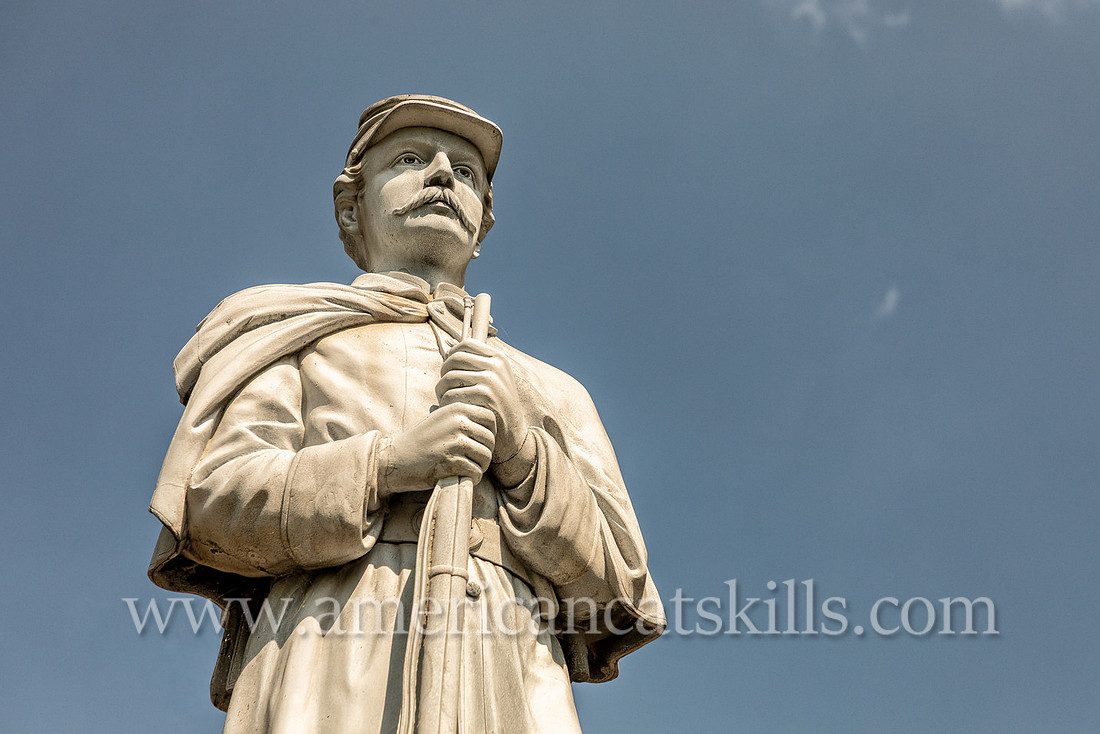
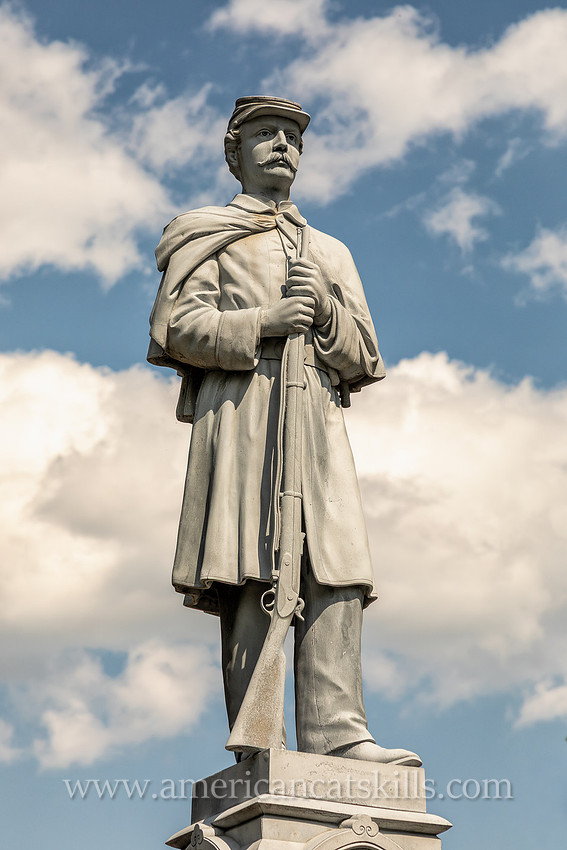
The monument depicts a full-length figure of a relaxed yet vigilant Union soldier standing guard. The soldier stands at parade rest and wears a uniform and cap. The cape of his overcoat is thrown over his proper right shoulder. He holds the barrel of a rifle with both hands, while the butt of the gun rests on the ground near his feet.
The zinc sculpture stands atop an elaborate granite pedestal. On each of the four sides of the pedestal is a relief portrait bust. On the front of the pedestal is the portrait bust of Abraham Lincoln in proper right profile. The other portraits depict Grant, Sherman and possibly Scott.
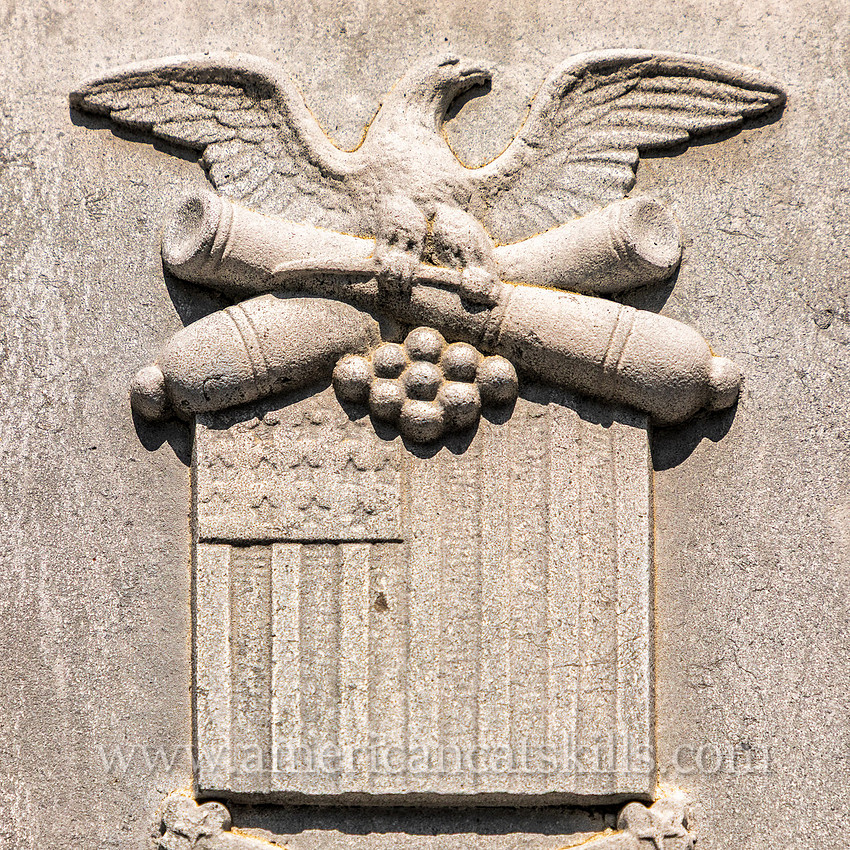
Below the portraits are relief emblems of the four branches of the service, including crossed sabers and an anchor. The base ends in three steps, the bottom of which is concrete cast to resemble rough-hewn granite.
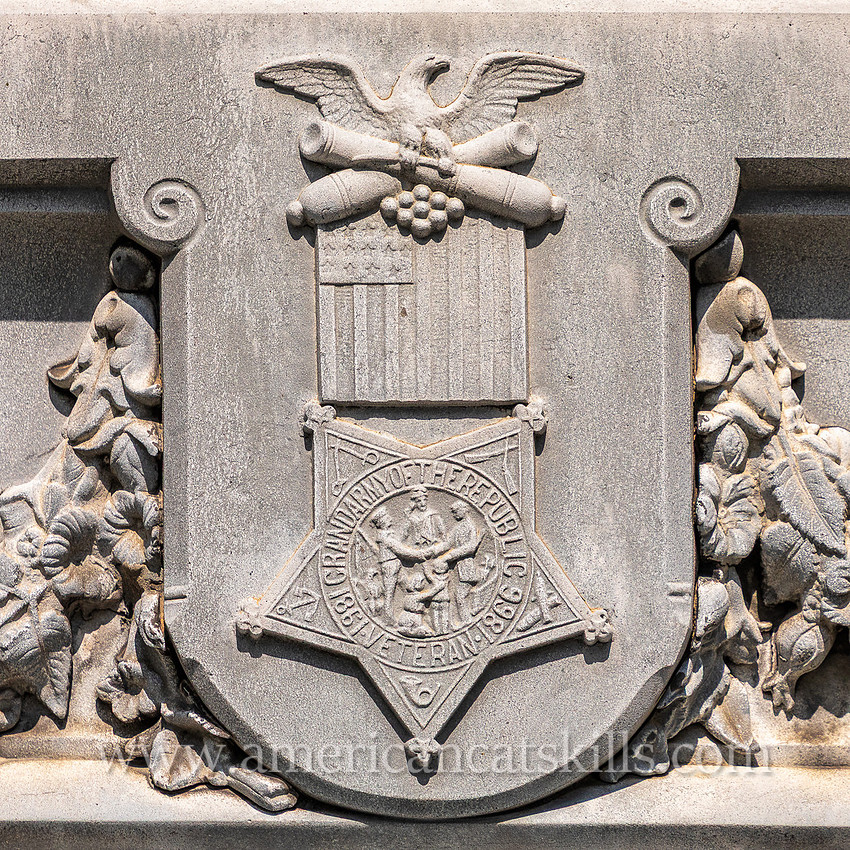
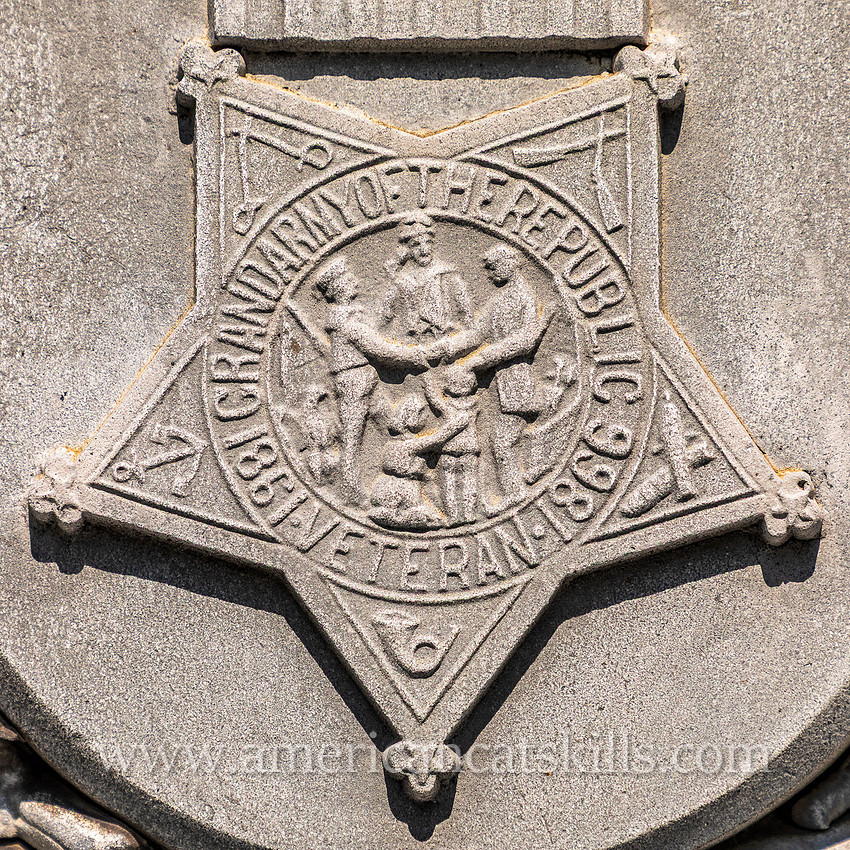
An inscription on the front of the base reads “In memory of John E. Lasher, a friend of the soldiers. This monument is presented to J. R. Tappan Post, No. 215, G. A. R., By his son, Alfred P. Lasher, 1904.” The Grand Army of the Republic (G.A.R.) was a fraternal organization of veterans of the Union Army.
The front of the base is also inscribed with the Abraham Lincoln quote “With malice toward none and charity for all.”
The right-side plaque is inscribed with the words “Erected in memory of the soldiers and sailors of the Town of Saugerties.”
The rear plaque reads “Erected under the auspices of J. R. Tappan Post, No. 215, G. A. R. Department of New York.”
The left-side plaque lists the committee members, including W. H. Maxwell, chairman; J. Smith Elmendorf, secretary; George E. Carnright, treasurer; and E. L. Quick, A. P. Post, Abram Tuck, P. S. Wickham, committee.
On the sides of the monument, there are inscriptions dedicated to the battles of Gettysburg, Fredericksburg, Cold Harbor, Williamsburg, Appomattox, Winchester and Wilderness.
The sculpture of the soldier stands 7 feet tall, while the entire monument, including the base, is approximately 16 feet, 10 inches tall.
History
The statue was shipped from Bridgeport, Connecticut in late September 1904 and was placed on its original position on Ulster Avenue in the village of Saugerties in early October 1904. The statue was officially dedicated in October 1904.
When increased traffic made it necessary to remove it, the memorial was moved to its present site on Partition Street, between Main Street and Lafayette Street.
According to the Smithsonian American Art Museum, the monument was created by an unknown sculptor.
Colonel Roger Donlon
“Life will spin you around but stay on the azimuth. With faith, you will make progress towards your goal and purpose.” – Colonel Roger Donlon
The park where the statue is located is named in honor of Colonel Roger Donlon (1934-1924), who was awarded the Medal of Honor for his actions on July 6, 1964 while serving in Vietnam as the commanding officer of the U.S. Army Special Forces Detachment A-726 at Camp Nam Dong.
Captain Donlon was presented the Medal of Honor on December 5, 1964 by President Lyndon B. Johnson in a ceremony held in the East Ballroom of the White House in Washington, DC. After the ceremony, President Johnson took Donlon on a personal tour of the White House.
Donlon was the first service member awarded the Medal of Honor for actions during the Vietnam War as well as being the first Special Forces soldier in history to receive the award.
The battle in which Donlon earned the Medal of Honor loosely inspired the climactic scene in the 1968 John Wayne movie “The Green Berets.”
Growing up in Saugerties, Roger was the eighth of ten children born to Paul A. and Marion (Howard) Donlon of Saugerties. His father passed away when he was 13 years old. He was born and raised in the house on the corner of Main Street and Mynderse Street in Saugerties.
Donlon attended St. Mary’s School and Saugerties High School. He was an altar boy, a boy scout and the first drum major in the Father Harty Drum Corps. When the football program was revived at Saugerties High School, he played on the very first team. He served as Vice President of the senior class and President of the junior class. He worked as a soda jerk in the Sweet Shop while attending high school.
Donlon graduated from Saugerties High School in 1952 and attended the New York State College of Forestry at Syracuse University for one year. He then enlisted in the U.S. Air Force as an airman in 1953 and served for two years until 1955. He obtained an appointment to West Point in 1955, but resigned from the academy two years later for personal reasons. He next worked as a programmer for IBM for a short time. In 1958, he re-enlisted, this time in the US Army, as a private in the infantry and later graduated from Officer Candidate School at Fort Benning, Georgia. Donlon was commissioned as an infantry officer in 1959. He joined the Special Forces in August 1963.
Donlon earned a bachelor’s degree from the University of Nebraska at Omaha in 1967 and his master’s degree from Campbell University in North Carolina. He was also the recipient of an Honorary Master of Military Arts and Sciences from the Command and General Staff College at Fort Leavenworth, Kansas, and an Honorary Doctorate of Humane Letters from Benedictine College in Atchison, Kansas.
Donlon retired from the military in 1988 after serving for more than thirty years. He was the author of two books about his experiences in Vietnam, including Outpost of Freedom (1965) and Beyond Nam Dong (1998). Colonel Roger Donlon died on January 25, 2024 and is buried at Fort Leavenworth National Cemetery in Fort Leavenworth, Kansas.
The Medal of Honor award citation describes Captain Donlon’s heroism. “For conspicuous gallantry and intrepidity at the risk of his life above and beyond the call of duty while defending a U.S. military installation against a fierce attack by hostile forces.
Capt. Donlon was serving as the commanding officer of the U.S. Army Special Forces Detachment A-726 at Camp Nam Dong when a reinforced Viet Cong battalion suddenly launched a full-scale, predawn attack on the camp. During the violent battle that ensued, lasting five hours and resulting in heavy casualties on both sides, Capt. Donlon directed the defense operations in the midst of an enemy barrage of mortar shells, falling grenades, and extremely heavy gunfire.
Upon the initial onslaught, he swiftly marshaled his forces and ordered the removal of the needed ammunition from a blazing building. He then dashed through a hail of small arms and exploding hand grenades to abort a breach of the main gate. En route to this position he detected an enemy demolition team of three in the proximity of the main gate and quickly annihilated them. Although exposed to the intense grenade attack, he then succeeded in reaching a 60-mm mortar position despite sustaining a severe stomach wound as he was within five yards of the gun pit.
When he discovered that most of the men in this gun pit were also wounded, he completely disregarded his own injury, directed their withdrawal to a location 30 meters away, and again risked his life by remaining behind and covering the movement with the utmost effectiveness. Noticing that his team sergeant was unable to evacuate the gun pit he crawled toward him and, while dragging the fallen soldier out of the gun pit, an enemy mortar exploded and inflicted a wound in Capt. Donlon's left shoulder. Although suffering from multiple wounds, he carried the abandoned 60-mm mortar weapon to a new location 30 meters away where he found three wounded defenders.
After administering first aid and encouragement to these men, he left the weapon with them, headed toward another position, and retrieved a 57-mm recoilless rifle. Then with great courage and coolness under fire, he returned to the abandoned gun pit, evacuated ammunition for the two weapons, and while crawling and dragging the urgently needed ammunition, received a third wound in his leg by an enemy hand grenade.
Despite his critical physical condition, he again crawled 175 meters to an 81-mm mortar position and directed firing operations which protected the seriously threatened east sector of the camp. He then moved to an eastern 60-mm mortar position and upon determining that the vicious enemy assault had weakened, crawled back to the gun pit with the 60-mm mortar, set it up for defensive operations, and turned it over to two defenders with minor wounds.
Without hesitation, he left this sheltered position, and moved from position to position around the beleaguered perimeter while hurling hand grenades at the enemy and inspiring his men to superhuman effort. As he bravely continued to move around the perimeter, a mortar shell exploded, wounding him in the face and body.
As the long awaited daylight brought defeat to the enemy forces and their retreat back to the jungle leaving behind 54 of their dead, many weapons, and grenades, Capt. Donlon immediately reorganized his defenses and administered first aid to the wounded. His dynamic leadership, fortitude, and valiant efforts inspired not only the American personnel but the friendly Vietnamese defenders as well and resulted in the successful defense of the camp.
Capt. Donlon's extraordinary heroism, at the risk of his life above and beyond the call of duty, are in the highest traditions of the U.S. Army and reflect great credit upon himself and the Armed Forces of his country.”
Colonel Roger Donlon Veterans Park
Colonel Roger Donlon Veterans Park in Saugerties, New York was dedicated in 1989 to celebrate the 25th anniversary of Donlon earning the nation’s highest award for valor. Two other members of Donlon’s Green Beret team that helped defend Camp Nam Dong attended the dedication, including Sergeant Thomas L. Gregg, the team “medic” who Donlon credited with saving his life after he was wounded four times, and Staff Sergeant Merwin D. Woods, who in charge of the heavy weapons at the Nam Dong camp.
As part of the events, a public reception was held at Legion Hall in Saugerties. Donlon also served as the grand marshal for the Saugerties Independence Day parade. Ulster County Legislative Chairman Richard B. Matthews proclaimed July 6, 1989 to be “Roger Donlon Day” in Ulster County.
The Saugerties festivities marked the kickoff of a national effort named “America Discovers Her Hometown Medal of Honor Heroes,” sponsored by the non-profit Congressional Medal of Honor Society of the United States. The goal of the organization was to educate Americans about the unique history of the award; to mobilize thousands of school children, educators and ordinary citizens to become hometown researchers; to place VA headstones on the graves of Medal of Honor recipients; and to locate over 400 recipients of the award for who disappeared with no record of where they died and were buried.
