
The Old Guard House at Hurley, New York
The Old Guard House, also known as the Spy House or the Du Mond House, is located on Main Street in the historic hamlet of Hurley, New York. The house was built prior to 1685, making it the oldest house in the Hurley historic district. The house has been used as a residence, a pub, an ice cream parlor, a post office and a general store.
The Old Guard House is listed on the National Register of Historic Places as part of Hurley Historic District. It was described as “1 1/2-story stone house, with the stones extending into the gables, which are of notably steep pitch. The central brick chimney suggests the building may have been added to at an early date. The main block exhibits considerable integrity, with the only likely additions [being] the scalloped bargeboard and small portico. However, a modern 1-story stone post office has been attached at the northeast corner.”
George C. Kent purchased the house in 1933, after it had been in the DuMond family for many years. In 1934, one year after purchasing the house, Kent opened an ice cream parlor in the house under the name of the “Old Guard House.” Kent later operated a general store from the Old Guard House.
George Kent left the house to his son, Don Kent (1917-2019), a retired Air Force public affairs officer, who then lived there since 1985. Continuing the tradition started by his father, Don actively participated every year in Hurley’s Stone House Day, a special summer day when the owners of the hamlet’s Revolutionary era homes would open their doors to the public for tours and to share the history behind each one.
In a 2002 interview with the Daily Freeman, Don stated that the living room and dining room were original, and that the additions had been made throughout the years, including a post office that later served as a store. The post office operated from 1953 to 1986.
“Other points of interest include original glass window panes with bubbles, door hardware forged in the 1690s, massive oak beams and wide floor boards. The décor is eclectic, including modern furniture and appliances as well as a collection of pieces passed down from the Victorian era, including a tall, free-standing mirror in decorative wooden frame, an organ and a dental cabinet.” (Langston.)
Don, at 93 years of age, put the Old Guard House up for sale in 2011 after having lost his wife in January of that year. “Kent's descendants wanted to keep the home in the family, but nobody wanted to live there. And with insurance companies assessing the 3000-square-foot home at more than $1 million, maintaining the family heirloom was just too expensive.” (Novinson.)
Don finally, at 101 years of age, sold the house in 2019 to Katie Greaves and Alex Perfect. Katie was raised in Hurley and had always wanted to live in the house. Katie and Alex have kept the community tradition alive by opening their home, the “Old Guard House,” each year for Hurley’s Stone House Day.
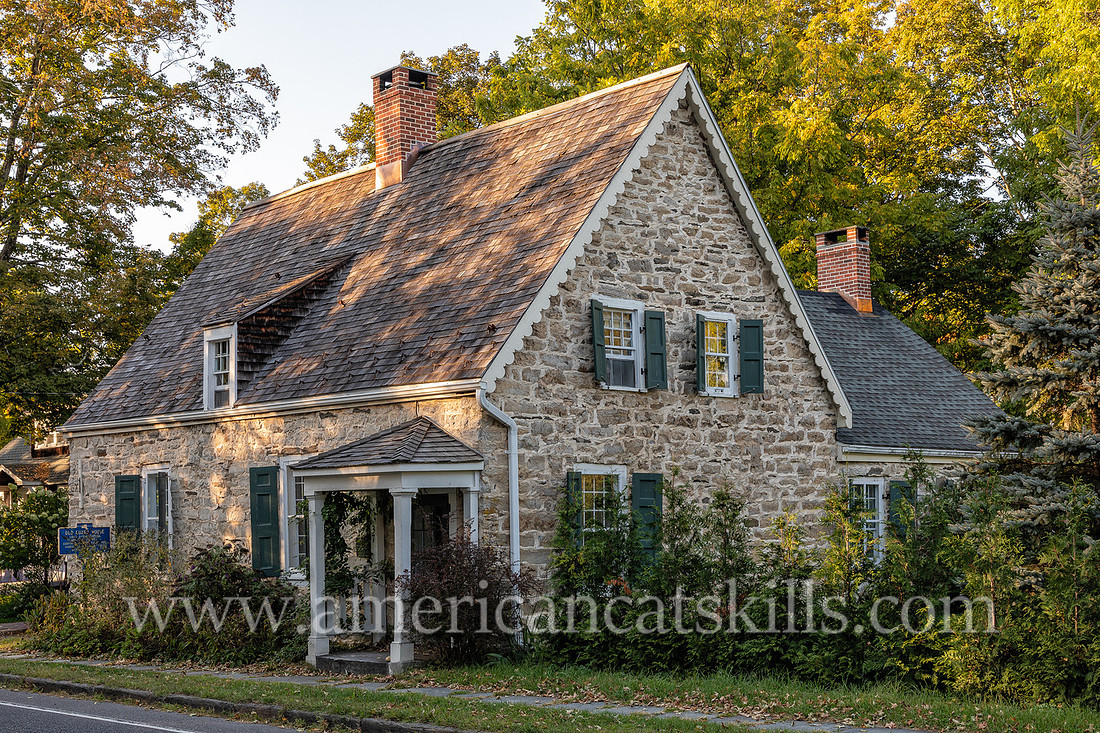

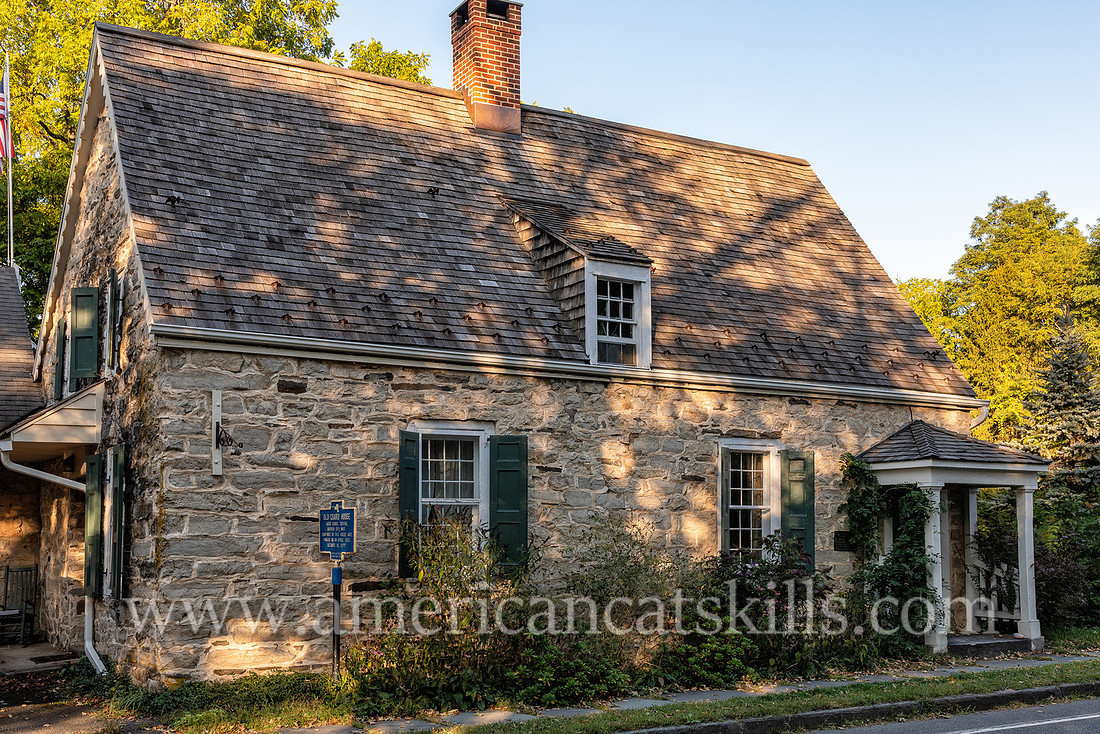
Revolutionary Intrigue
The Old Guard House, or the Spy House, played a significant role in an episode of military intrigue during the American Revolution.
In the fall of 1777, during the early stages of the American Revolution, British General Henry Clinton was proceeding north up the Hudson River in the hopes of linking up with General John Burgoyne, who was located at Saratoga after having advanced south from Canada. General Henry Clinton captured both Fort Montgomery and Fort Clinton on the Hudson River on October 6, 1777.
American General George Clinton’s command retreated from their defeats at Fort Montgomery and Fort Clinton to an encampment at Little Britain, New York.
After his tactical victory, British General Henry Clinton then sought to get a message through the American lines to inform General Burgoyne, then located at Saratoga, of his success. General Henry Clinton entrusted Lieutenant Daniel Taylor, an officer in Captain Stewart’s company in the 9th Regiment, of the British Army, with the mission to convey the secret message.
Capture
Dressed in civilian attire, Lieutenant Taylor left Fort Montgomery on horseback on October 8, 1777, and had traveled northward for about 15 miles over the course of two days.
On the night of Friday, October 10, 1777, in the neighborhood of Little Britain, New York, a picket-guard of Colonel Webb’s regiment, under the command of Lieutenant Howe, of the American army, captured within the lines “a suspicious person,” who proved to be Lieutenant Daniel Taylor of the enemy’s forces. It seems that Lieutenant Taylor was not aware that he had passed within the American lines and was further deceived by the uniforms of the American party, who were dressed in red coats, which had been recently captured from a British transport.
Upon seeing the red coats, Lieutenant Taylor assumed the soldiers to be British. Lieutenant Taylor then asked for the name of the commanding general. The Americans answered “General Clinton,” to which Taylor then requested to be taken to see him.
Upon being escorted to the headquarters, Taylor quickly realized that instead of being in front of British royal commander Sir Henry Clinton, he found himself in front of American Governor George Clinton. Upon realizing his mistake, Taylor declared “I am lost!” in a half-subdued voice. He was then immediately observed putting something in his mouth and swallowed it. The object turned out to be a “curiously-wrought, hollow sphere,” a small silver ball of oval form, about the size of a bullet, that was fastened shut with a compound screw in the middle.
Upon seeing him swallow the object, Governor George Clinton ordered that Lieutenant Taylor be given “a very strong emetic, calculated to set either way. This had the desired effect; it brought it from him; but, though close watched, he had the art to conceal it a second time.”
General Clinton then made Lieutenant Taylor “believe I had taken one Capt. Campbell, another messenger, who was out on the same business; that I learned from him all I wanted to know, and demanded the ball on pain of being hung up instantly and cut open to search for it. This brought it forth.”
Dr. Moses Higby
Dr. Moses Higby, then residing at “the Square,” administered the tartar emetic which afforded such convincing proof of Taylor’s allegiances. For his contribution to the war effort, “the Dr. ever afterwards, prided himself greatly on that incident in his practice, which he neither forgot nor permitted any one else to disremember, or be ignorant of.”
Dr. Higby was among the earliest of his profession in this section of Orange County. He “had but a common education, though considered good for the times, and what he lacked in this, strong natural talents, observation and extensive practice made up.”
“That he [Higby] had taken part in the war by being connected with the discovery of the silver ball, his acquaintance personally with the officers of the American army, who lay encamped 1782-3 around his dwelling, and being the principal physician in the settlement, imparted at least a fictitious, if not a real consequence to his character and personal bearing. Of all these interesting incidents and connections the doctor was fond and inclined to recur on proper occasions. His practice was among the old and respectable families in this town and New Windsor, and this, of itself, was a flattering circumstance.” (Eager, p. 170.)
Dr. Moses Higby died on May 3, 1823, “upwards of 80 years of age, having practiced medicine for over 60 years.” (Eager, p. 171.)
The home of Dr. Moses Higby, known as the Higby House, is located at the corner of Cedar Avenue and Union Avenue in New Windsor, New York. There is a historic marker outside the house along the road that reads: “Higby House. Home Of Dr. Moses Higby, Who Removed from Daniel Taylor, British Spy, A Silver Bullet with Message from Sir Henry Clinton to Burgoyne.”
The Secret Message
Upon obtaining the silver ball from Lieutenant Taylor, the Americans opened it and found inside a piece of thin paper. The message within the capsule from British General Clinton to General Burgoyne read:
“Nous y voici [Here we are], and nothing now between us but Gates. I sincerely hope this little success of ours may facilitate your operations. In answer to your letter of the 28th Sept., by C. C., I shall only say I cannot presume to order, or even advise, for reasons obvious. I heartily wish you success. Faithfully yours, H. Clinton.”
The short note was fairly innocuous as it contained no critical intelligence on American movements and no details of British military plans.
The C. C. mentioned in the secret message, and to whom General Clinton had referred, was Captain Campbell, another spy for Sir Henry Clinton who was more fortunate and reached General Burgoyne on October 16th, the day that the city of Kingston was burned.
Court Martial
On Tuesday, October 14th, General Clinton ordered a general court-martial for the trial of Lieutenant Taylor. The court-martial was held at the heights of New Windsor. The court was comprised of Colonel Lewis Du Bois as president, and the following members: Majors Bradford and Huntington, and Captains Ellis, Savage, Watson, Wyllis, Gillespie, Conklin, Wood, Hamtramk, Lee and Husted.
The charge against Lieutenant Taylor was “lurking about the camp as a spy from the enemy.” Lieutenant Taylor pled not guilty, but had “confessed his being an express from Gen. Clinton to Gen. Burgoyne when taken.”
During his confession, Lieutenant Taylor stated that “I left For Montgomery yesterday evening with a charge from General Clinton to go to General Burgoyne and acquaint him that he had landed about five miles below the fort, clambered over the mountains, and stormed with small arms the back part of the Fort, which he carried with the loss of Lt. Col. Grant, of Regt. Volunteers, Major Campbell, Major Sela, a number other officers and about 300 rank and file, that the obstructions in the river were now nearly removed and that he, General Burgoyne, might now move forward or go back, and to acquaint him that General Howe was near Philadelphia, and had defeated the Rebels; and that the Frigates belonging to the Rebels in the River were both burnt.
A Captain Campbell had come from General Burgoyne to General Clinton with dispatches, and set of on his return, on Tuesday, morning ye 7th inst.
I left General Burgoyne 6 mile above Fort Edward the last of July, with orders to acquaint the commanding Officer in New York, that the Roads were so broke up it was extremely difficult, but so soon as he could clear the way he should advance.
I was likewise to inform General Burgoyne that they had now the Key of America (say the passes through the Highlands of Hudson’s River.)”
During the trial, “the prisoner plead that he was not employed as a Spy, but on the contrary was charged both by General Clinton and Burgoyne not to come near our Camp but meeting accidentally with some of our Troops, in British Uniform, he was thereby deceived, and discovered himself to them.”
The court was not convinced by Taylor’s argument. The court, “after considering the case, were of opinion that the prisoner is guilty of the charge brought against him, and adjudged him to suffer death, to be hanged at such time and place as the General shall direct.”
The Execution of Lieutenant Daniel Taylor
After the British capture of both Fort Montgomery and Fort Clinton on October 6th, British General Henry Clinton directed his forces under the command of Lieutenant-General Sir John Vaughan to raid the Hudson Valley. Vaughan sailed northward on the Hudson River towards the city of Kingston.
In response, the remaining army of Governor George Clinton, composed of about 1,000 men, moved northward from Little Britain along the Wallkill River in an attempt to meet the British and save the city of Kingston. Lieutenant Taylor was taken along on this march.
The Americans did not arrive in time, and, on October 16th, the city of Kingston, then the capital of New York State, was attacked and burned by the British. The British troops landed at Kingston Point and marched to the Stockade District of Kingston, burning houses along the way. After only a few hours, the British had burned down over 300 buildings and left the city in ruin.
The advanced guard of the Americans were only able reach “the “Kuykuyt, overlooking Kingston, to behold the village in flames and the enemy nearly retired to his shipping. Had the whole army been at hand it could not, of course, have prevented the destruction of the village, or made any serious resistance to the royal troops.” (Pratt, p. 25.)
“The injury done to the inhabitants [of Kingston] was more than most of them could bear; many persons in comfortable and even affluent circumstances were reduced to absolute want, and all were forced to seek shelter at some distance from their late pleasant homes. The conduct of the cruel foe met with an indignant cry from all parts of the continent, and it steeled the hearts and nerved the arms of our countrymen to pursue with unabating energy the course of resistance to British Tyranny.” (Pratt, p. 38.)
American General George Clinton, as he gathered information and weighed his next moves, established his military outpost at Hurley because of its proximity to Kingston and its command of important roads. Hurley was located approximately three miles southwest of the Stockade District of Kingston.
While the Americans were encamped at Hurley, Lieutenant Taylor, along with other prisoners, was held in the basement of the Du Mond House. Due to Lieutenant Taylor’s imprisonment there, the house was later commonly referred to as the Old Guard House or the Spy House.
On Thursday, October 16th, Governor George Clinton, perhaps with the thoughts of the burning of Kingston fresh in his mind, upheld the court-martial verdict. “The sentence of the General Court-Martial, whereof Col. Du Bois was President, against the within named Daniel Taylor, is approved. And ordered to be carried into execution when the troops are paraded and before they march tomorrow morning. Geo. Clinton, B. Gen., Continental Army.”
Despite the order from Governor Clinton to execute Lieutenant Taylor on Friday, October 17th, the order was not carried out that day, presumably because the attention of the troops was taken up with other matters after the burning of Kingston.
The morning report on Saturday, October 18th, of John Ellis, Officer of the Guard, of the Main Guard of Governor Clinton’s Army at Hurley reported that he had “visited the sentinels frequently, found them alert, on their posts. No Grand Rounds. Nothing material happened.” (Pratt, p. 65.) There were 34 prisoners being held at the time, of which Lieutenant Taylor was one. There was also Isaac Van Vleck, who, like Lieutenant Taylor, was also “taken up as a Spy.”
Other prisoners included William Mohany, who was “confined for saying the Rebels were retreating before Gen’l Burgoyne & that he hoped the Rebels would be beat.” Thomas Porter was being held “for speaking disrespectfully of our General and Under Officers that commanded at Fort Montgomery and for saying that if it had been commanded by British Officers it would not have been given up.”
Bart Miller was confined “for being an Enemy to his Country and saying that he was a friend to George the Third, King of Great Britain.” Jacob Lowes was held for saying he “was raising a Company for the British service.” Nine people were “charged with being Enemies of the States & being found In Arms against the States.”
In the afternoon of Saturday, October 18th, eight days after his capture, Lieutenant Daniel Taylor was hung from an apple tree near the village of Hurley. “From the trunk projected towards the west a large limb about ten feet above the ground. To this the noose was attached.” The tree stood until a few years after 1840, “and bore a sweet red apple.”
The Ulster Sentinel published a detailed account of the hanging in its September 26, 1827 issue. ''He [Taylor] had a long, thin rope around his neck, which was coiled and carried after him by a soldier. On halting at Marbletown he was led into the church, then used as a depot, and being seated near the pulpit the poor wretch bent himself forward to hide his face, and the rope was then coiled upon his back.
At Hurley, three miles from the smoking ruins of Kingston, Taylor was hung on the bough of an apple tree in a by street, not far from the village. The contrivance for his exit into eternity exemplified the rude expedients of the times. A hogshead was placed under the bough, the culprit mounted upon it, and the rope being fastened above, the executioner kicked the hogshead over. He fainted, however, before the fatal kick was given, and thus had an apparently easy death.
Jack Ketch, on this occasion, was performed by a soldier, who received, as per agreement, the dead man's boots for his reward.''
“Jack Ketch” was not the name of the Lieutenant Taylor’s actual executioner, but was a general reference to a person who performed executions. The original “Jack Ketch” was an infamous English public executioner who performed his duties during the late 1600s. Due to his barbarity and botched and bloody executions, the term “Jack Ketch” became synonymous with death and executioners.
The body of Lieutenant Taylor hung from the tree for at least two days. American soldiers encamped in the area were paraded by the body as a warning to any potential British sympathizers.
The Guard Report for Governor Clinton’s Army at Hurley of Sunday, October 19th has the name of Lieutenant Taylor crossed out.
James Rivington, in the November 22nd issue of his loyalist New York newspaper, only made a brief mention of Lieutenant Taylor’s death, reporting that “Mr. Taylor, a spy, taken with a letter to Burgoyne, was hanged Thursday last at Hurley – Fish-kill dispatch of 23 Oct.” (Scott, p. 130.)
The Diary of Nathaniel Webb
Nathaniel Webb, an officer in the Second New York Regiment, wrote in his diary about the dramatic events of October 17-18, 1777.
“17. Friday – Army marches to Hurley, a precinct in Kingston, and encamped. The enemy advanced up ye River, burning wherever they dare land yar troops. Ys evening we have certain intelligence yt Gen. Burgoyne and his army of 5,000 men have just submitted prisoners upon articles of capitulation – an event most happy, and demands the highest thanks of all Americans to ye God of armies.
18. Saturday – Mr. Taylor, a spy, lately taken in Little Britain, was hung here [Hurley]. The Rev. Mr. Romain and myself attended him yesterday [October 17], and I have spent the morning discoursing to him, and attended him at ye gallows. He did not appear to be either a political or a gospel penitent.” (Ruttenber, p. 76.)
The Hanging Apple Tree and Grave
According to the Kingston Daily Freeman in an article published on October 29, 1904, several interested parties were then trying to find the exact spot on which Taylor was executed and buried. They interviewed several of the oldest members of the community.
“The apple tree stood directly in the rear of the Van Sickle house, and the grave in which the spy lies is about ten feet in front of the flagstone lying in front of the front door. When the late Thomas Houghtaling was a school boy the mound over the grave was distinctly visible, and it was the proper thing for patriotic lads to dance upon it. He frequently pointed out the spot to visitors until within a short time of his death.
Measurements of the locality, including the site of the grave, were taken for a map of the surroundings, and it is the purpose of those in charge of the identification of Uster’s historic spots to have erected here a lasting memorial.
The exact site of the tree was 42 1/10 feet from the south corner of the Van Sickle house at a point 60 2/10 feet from the northwest corner of the kitchen. Here a long iron bar was driven deep into the ground, its top being left even with the surface.”
In 1901, local newspapers reported that the bones of a human being, a horse and several Native American implements of warfare and defense were unearthed by workers excavating for the Ellenville and Kingston Railroad near Hurley. At first, it was believed that the remains were those of an Indian chief and his horse, it having been custom to bury the chief’s effects by his side, for use in the happy hunting grounds, to which he was presumed to have gone. However, others believed that the skeleton was that of Lieutenant Taylor. Unfortunately, there were no follow-up articles on what happened to the bones or if the remains were, in fact, those of Lieutenant Taylor.
Aftermath
It did not take long for Sir Henry Clinton to learn “that his ‘silver bullet’ letter had been intercepted after Brigadier Vaughan sent him a page from the New-York Packet, published at Fishkill on October 16, 1777, which printed a letter from George Clinton to Israel Putnam, dated New Windsor, October 11, 1777, detailing Taylor’s capture and reprinting the note.” (Brumwell.)
It is unlikely that General Clinton’s message getting through to General Burgoyne via Lieutenant Taylor would have made even the smallest difference in the course of the conflict in the Hudson Valley, as the Americans had already decisively won the Battle of Saratoga on October 7, 1777, three days prior to Taylor’s capture.
General Burgoyne would seek to escape with his troops to the north on October 8, 1777, but would ultimately surrender his entire army at Saratoga to American General Horatio Gates on October 17, 1777, one day before the hanging of Lieutenant Taylor.
The Battle of Saratoga would prove to be a turning point in the American Revolution. The American defeat of the superior British army lifted patriot morale, furthered the hope for independence and helped to secure the foreign support needed to win the war.
Hurley notably served as the temporary capital of New York State for two months after Kingston was burned on October 16, 1777 by the British Army. George Washington visited the village for a public reception on November 16, 1782 during a tour to thank residents for their support during the Revolution.
American General George Clinton kept Lieutenant Taylor’s silver ball as a reminder of the dramatic events. It was passed down through several generations of Clinton’s descendants. The ball was displayed before the New York Historical Society on February 7, 1843 and eventually made its way into the permanent collection of the New York Historical Society.
George Clinton Genet, a great grand-son of Governor George Clinton related an interesting story about the bullet. “When the bullet was shown to a visitor to the Clinton family, many years ago, a cousin of his, then a lad, put it into his mouth and unintentionally swallowed it. It was recovered in the same manner as that by which Daniel Taylor was compelled to give it up.”
Historic American Building Survey
The Dumond House, or Spy House, was thoroughly researched in 1934 by Myron S. Teller as part of the Historic American Building Surveys. Teller, who lived his whole life in Kingston, New York, was an architect who specialized in the restoration of early American houses. He was the author of “The Early Stone Houses of Ulster County, N.Y.” Below is the full report on the house.
“The Dumond House is one and one-half stories high, and is built of limestone with a frame lean-to in the rear, or north side. The limestone walls are of various thicknesses, from a nearby quarry, with rather square ends laid up in mortar made of clay, and pointed with lime mortar outside.
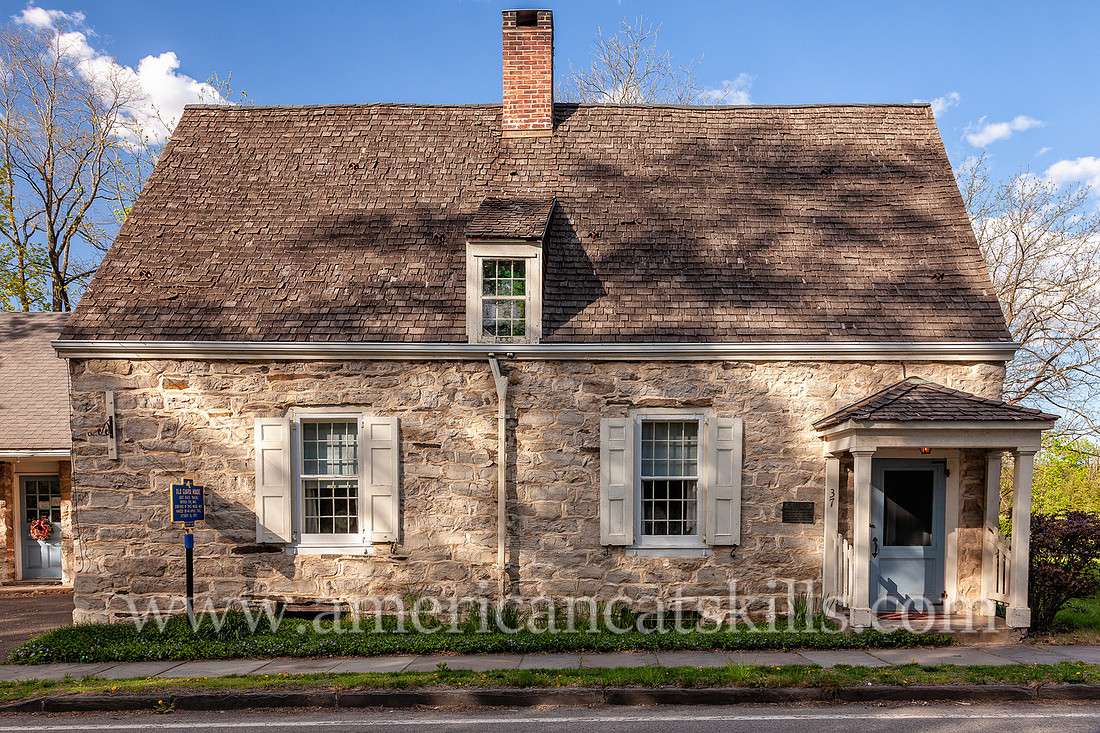
The steep pitched gables are built up in stone to the peak with an interesting verge board with scalloped edging.
It is interesting to note that the wall plate does not run through to the face of the gable walls, but is stopped about 7” from the end. This may be due to the style of verge board which overhangs the walls about 4”.
In most of the old houses the plate extends through to the face of the wall with the verge board set flat against the gable wall and broadened at the eave to cover and protect the end of the plate.
The front porch is no doubt of later date than the house. This had a ceiling panel that, when taken down by the owner, proved to be a Dutch door. The dimensions checked with the old log frame in opening number 1, which was exposed to examination. Impressions of a wrought iron lock case, key, and spindle hole also checked with an old lock fitted on one of the inside doors. This was probably not the original door. The molding on the face panels and bevel on the back of the panels on the other side matched those of the old window shutters and were no doubt installed at the time such changes and repairs were made. The use of a rim lock would also indicate a later date.
The original front door is thought to have been a Dutch batten door, similar to those shown on sheet number 9. Outside door openings number 2 and 5 are of quite recent date, as the doors, frames and lintels over the opening show.
The main portion of the house occupied by rooms A and B was built first, at which time cellar opening number 2 gave access from an area at the rear of the building, evidenced by the heavy oak lintel over this opening, which can by plainly seen and chamfered similar to that over the cellar area door number 3, built later. Portions of this rear wall were exposed and are pointed outside the same as the frame wall, and where the wall of the kitchen wing joins the main house, there is a vertical joint the full height of the wall. The roof was built over the main roof of the house where some portions of the old worn shingles remain under the rafters and boards, and gives evidence that this wing was a later addition.
The frame lean-to enclosing the space marked “Summer Kitchen” was added still later. Remodeling of this wing was begun by the present owner. The drawings show the windows, doors, and clapboards in their original place taken in the survey before the alteration.
The old house was originally roofed with hand split pine shingles 30” long, and laid about 12” to the weather, as measured on a full length shingle found in the attic under the lean-to roof, and preserved by the present owner.
The front dormer was no doubt built in the roof at some later date.
The floor beams are of heavy hand hewn timber, exposed and mostly of oak in the cellar, with some pine for the second floor used. The pine beams are mostly smooth dressed, and painted. They vary in both size and spacing, as shown on the plans and sections.
The floor boards are mostly of pine, 1 1/2” thick, splined, and many of them measure 16” and 17”, in width. These were nailed to the beams with hand made spikes. Owing to the varying widths these floor boards were laid with all ends finished to a line on one beam without breaking the joints as in modern work.
Frames of both doors and windows are worked out of heavy oak, framed and pinned at the corners. They are set within 1” of the face of the walls and the head functions as a lintel supporting part of the wall over it. Another plank shaped lintel about 4” to 5” thick is laid on top inside, and supports the remaining thickness of the wall.
The windows in walls supporting floor beams are set between the beams and the heads raised close to the floor above. Therefore the sills are higher than those in the end wall.
The window jamb reveals are made of single wide board – these on the three windows in the southeast wall are set with a splay – the others straight. The top sash is fixed. The bottom sash slides up and is held with notched wood buttons in some cases.
The door frame of opening number 9 is finished with a heavy molded pine head-piece on the inside, and inside door number 10 has a head-piece both sides as shown on the detail sheet. This is spiked to the head of the frame, typical of old Dutch houses in Ulster County.
The old doors remaining on the first floor are of three wide boards, varying in width with wide board battens as detail shows. These battens were secured to the boards on one side with hand made nails and the ends clinched in staple form, sunk with the grain and flush with the face of the board.
These doors were fitted with hand forged strap hinges set on battens and also fastened with nails clinched through the door. In some cases, leather pads are used under the nail head, which permitted of a tighter clinching. These hinges are hung on heavy pintle or hinge pins with spike ends which are driven into the oak frame.
The latches and handles are also hand forged. The latch bar is in practically all cases set with a slope or cant. This has a large nail at the end of the bar and a staple guide near the edge of the door. In the frame is a heavy catch-pin which engages and hold the end of the bar when the door is closed.
The spindle of the drop handle passed through door was clinched over the cam which laid under the latch. The end of cam rested in the guide as assembled on detail sheet number 10.
On the Dutch door this drop handle is on the upper half of door. The lower half of door has only a back latch which is operated from the inside.
Other minor doors are fitted with back latches on one side and thumb latch handles on the other. Some doors are now fitted with the Roggins cast iron thumb latches which are of a later date.
The central chimney is a part of the stone partition wall and above the second floor up and out through the roof is built square of the thin brick. In the cellar store rooms can be seen pieces of heavy blue stone flag built in and projecting 4” to 5” each side of the wall. On one side this shelf is used to support the spring of an interesting hearth arch built of old brick.
On the other side of the wall, instead of an arch, there are two heavy locust posts with cross pieces framed in and pinned, with heavy cross poles laid over on which the support of the overhang of fireplace and hearth is built.
The hearth in room “A” has been removed and the fireplace closed to accommodate a modern heater flue which breaks through the arch in the cellar. The original mantle shelf and facing is still left. The boards from shelf to ceiling have been removed, also the cupboard built in the right-hand jamb, thus exposing the chimney shaft. From the top of shelf to the ceiling which the present owner stated he found covered with many layers of white-washing, indicates the house had been lived in with this exposed and that the mantle and facings were finished later.
The present owner, Mr. George Kent, has preserved the cupboard doors, frame, and some boards – these were checked with the chimney when the survey was made and are shown in the sectional drawing, sheet 8, in their original position.
In room “B” the old hearth has been replaced with cement, but the fireplace has the old shelly stone back wall and the splay of jambs is built of brick.
The rear kitchen chimney has two heavy stone wall piers in the cellar with poles built in and projecting to support the hearth over.
The fireplace in the kitchen has been filled in at the back with new stone, making it shallow. At the right is the bake-over with the opening, flue, and dome arch in good repair, except that the overhang on the outside of the wall has broken away, leaving portions of the old brick and supporting stone shelf still in place. The opening has been filled in flush with the wall in new brick.
The kitchen chimney has a simple board facing and shelf as shown in the section.
The original wall cupboard facings at the right of the fireplace are shown. These were found fitted against the back wall insider the closet now faced with plain boards and batten doors of recent date.
The outside walls of the rooms were originally plastered directly on the stone work and are still in this condition in the gable walls of the second floor bedrooms.
The present owner was furred and lined the walls of rooms “A” and “B” with sheet rock plaster board.
All first floor ceilings are formed by the boards of the second floor above, and are painted.
On the second floor the partitions in rooms “A” and “B” are old plaster work both sides. Partitions in room “C” are plastered over boards on room side with lath used as a furring. The ceiling of this room is of boards but of narrow and uniform widths while in other rooms the boards are wide and of varying widths.
The bedroom in the attic space over the kitchen, shown by dotted lines, was built with stud walls plastered on one side. The board ceiling is supported by 2” by 4” beams. When this room was built, the roof cross ties were cut out to make room for the ceiling height.
There is evidence of an old window opening closed up with stone in the rear of this wing at the point indicated. It is likely this room was made for help quarters and the stair from the summer kitchen was put in for access to this room. The insider cellar stair was then built under, as the trap door in the floor to the cellar area was no doubt less convenient for daily use and was only used when provisions were stored in the cellar. This area has not been used for some time and the door is nailed shut.
The main stair in the living room is not the original. The original stair was much steeper as the well-hole indicates and was enclosed with boards with a batten door at the base. There is a notch in the beams each side of this stair well where a small header indicates the line between the end of the wall and a former trap door in the second floor which was used as a granary.
There is also another trap door over room “B.” This existed at the time the survey was under way, and was fitted with hinges of leather or hide nailed on. This opened into a narrow space, partitioned off with boards, and the end opening to the attic is closed with a batten board panel held in place with wood turned buttons.”
Selected Sources:
Brumwell, Stephen. Turncoat. New Haven, CT: Yale University Press, 2018.
Collections of The Ulster Historical Society. Volume 1. Kingston: Hommel & Lounsberry, 1860.
“Daniel Taylor, The British Spy.” Olde Ulster. Volume 1, No. 8. August 1905.
Eager, Samuel. An Outline History of Orange County. Newburgh: S. T. Callahan, 1846-1847.
“Hurley’s Skeleton.” Nyack Evening Star. July 31, 1901.
Langston, Bonnie. “Hurley Opens Doors to History.” Daily Freeman. July 11, 2002.
Lossing, Benson J. The Pictorial Field-Book of The Revolution. Volume 2. New York: Harper & Brothers, 1852.
Monell, J. J. Washington’s Head-Quarters, Newburgh, N. Y., and Adjacent Localities. Newburgh, NY: E. M. Ruttenber, 1872.
Novinson, Michael. “Spy House Owner Placing Historic Site on the Market.” Times Herald-Record. July 11, 2011.
Pratt, George W. An Account of the British Expedition Above the Highlands of the Hudson River and of The Events Connected with the Burning of Kingston in 1777. Albany, NY: Munsell & Rowland, 1861.
Public Papers of George Clinton. Volume 2. New York and Albany: Wynkoop Hallenbeck Crawford Co., 1900.
Ruttenber, Edward M. History of the Town of New Windsor, Orange County, N. Y. Newburgh, NY: The Historical Society of Newburgh Bay and the Highlands, 1911.
Scott, Kenneth. Rivington’s New York Newspaper. Binghamton, New York: Vail-Ballou Press, Inc., 1973.
Sylvester, Nathaniel Bartlett. History of Ulster County, New York. Philadelphia: Everts & Peck, 1880.
Teller, Myron S. The Dumond House (Spy House), Historic American Building Surveys. New York, 1934.
“The Grave of Taylor The Spy.” Kingston Daily Freeman. October 29, 1904.
