
Esopus Meadows Lighthouse: A History and Photographic Study
Introduction
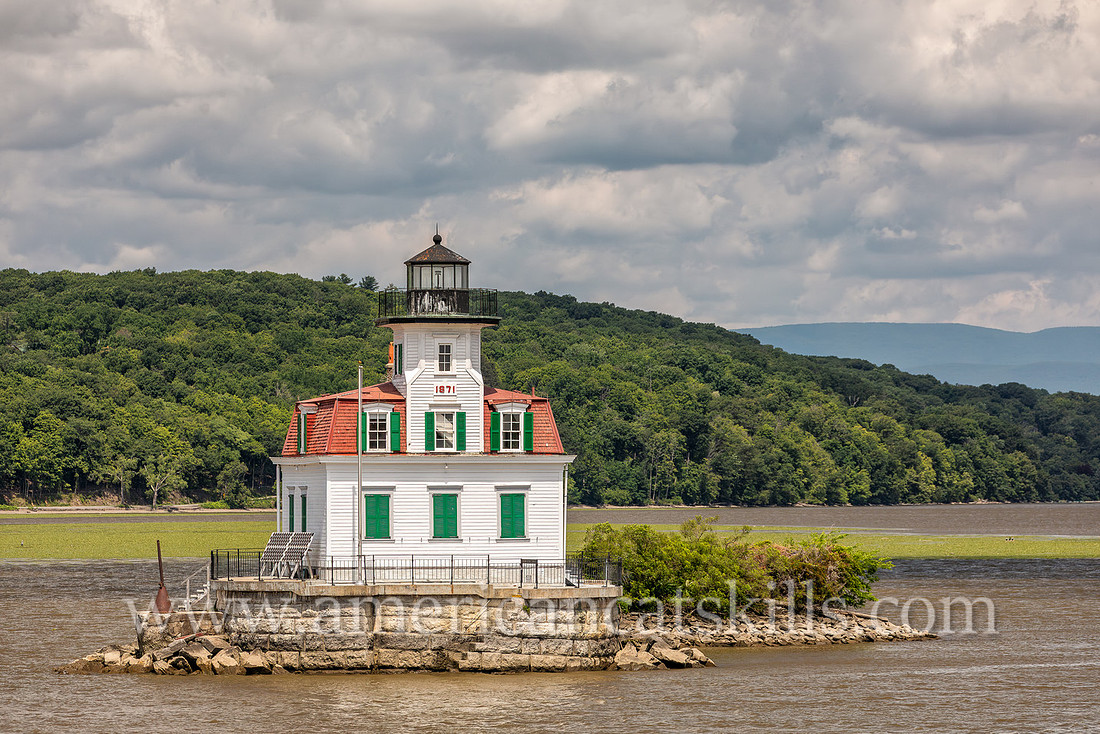
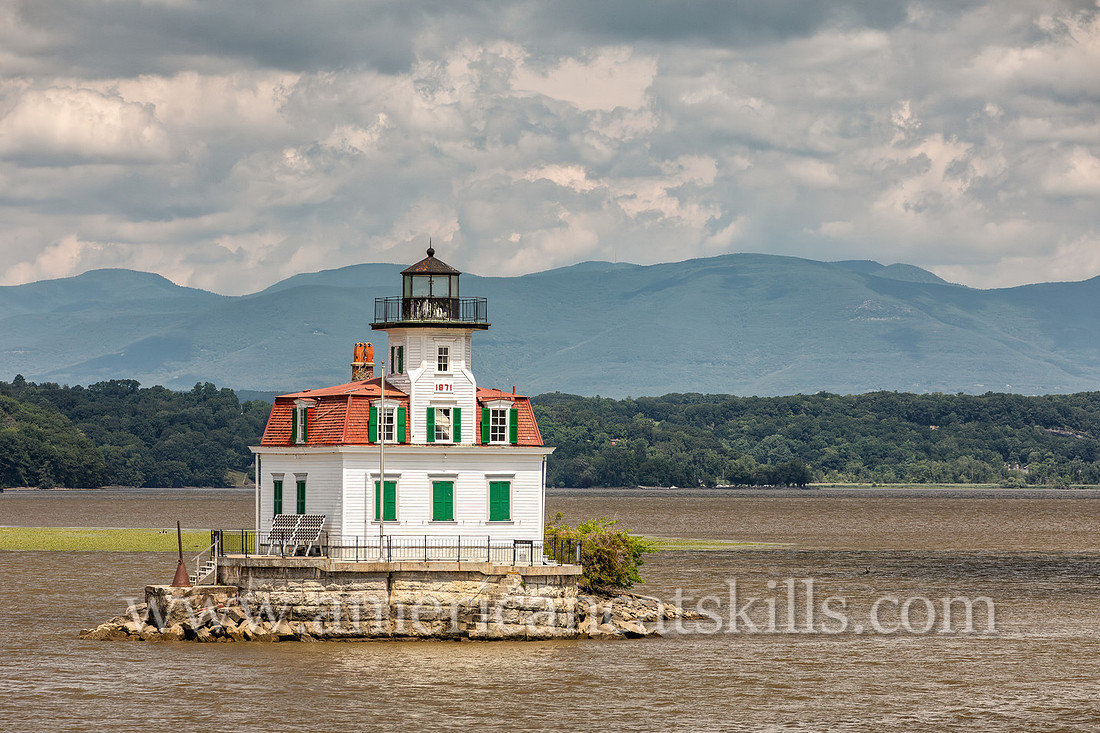
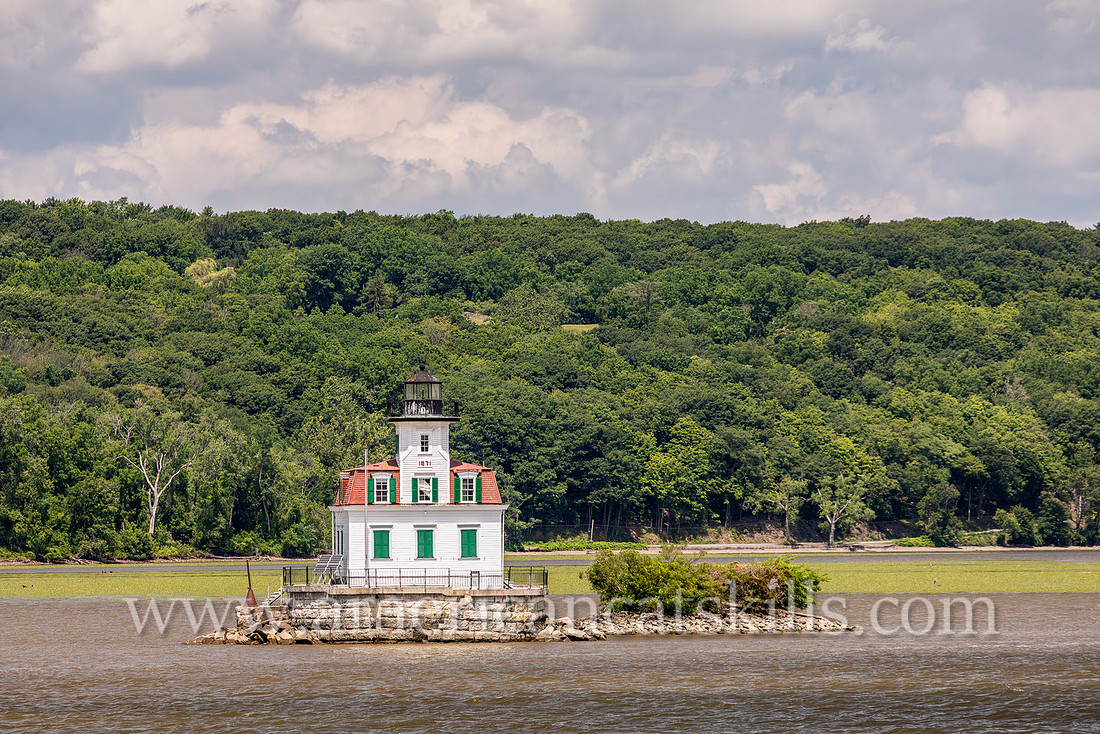
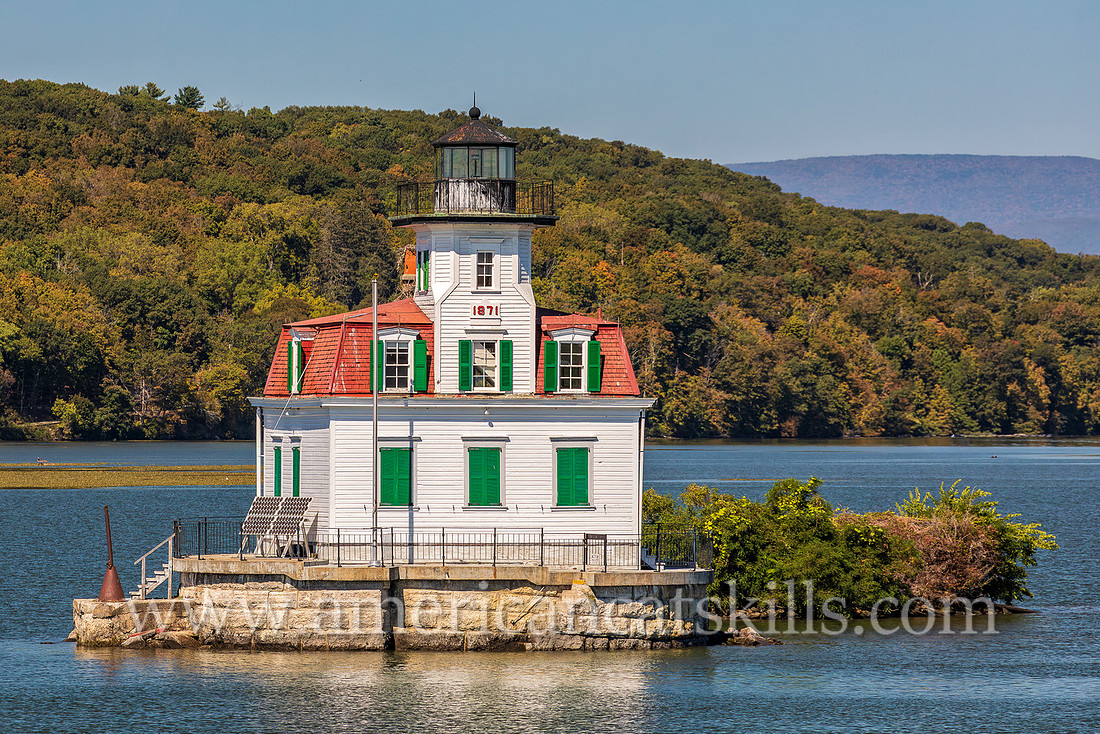
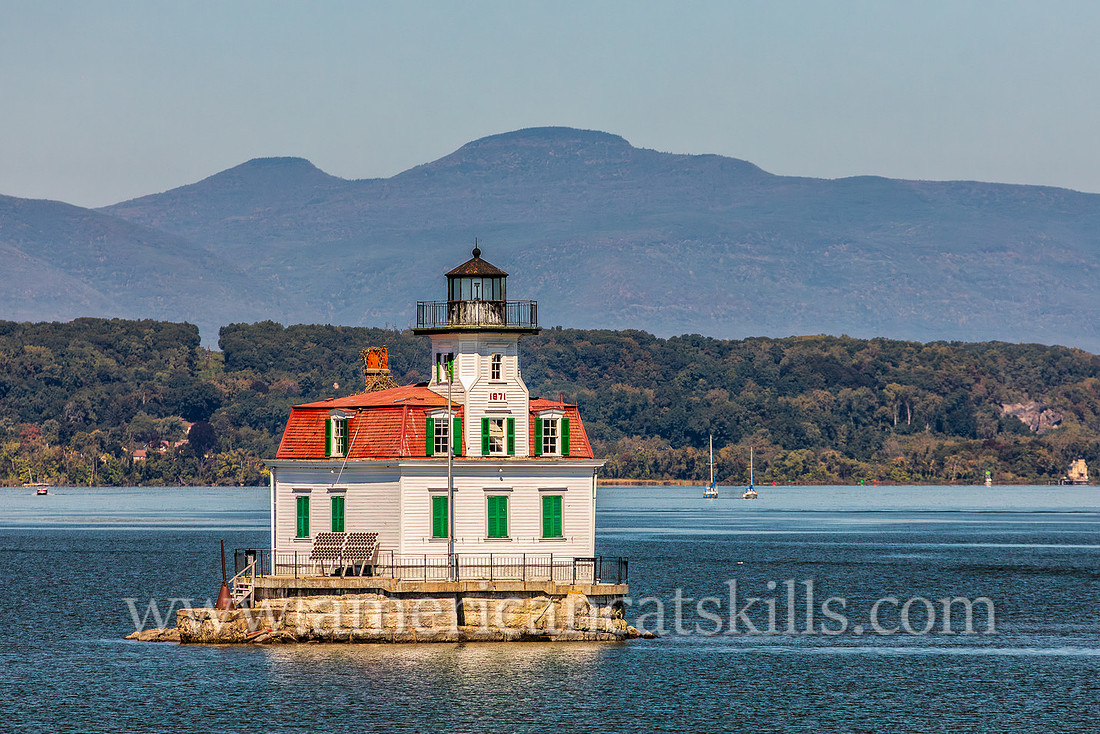
The Esopus Meadows Lighthouse, affectionately known as the Maid of the Meadows, is an active lighthouse located on the Hudson River between Poughkeepsie and Kingston. It is located at River Mile 87 on the Hudson River, as measured from the southern tip of Manhattan. The Hudson River is approximately 315 miles long.
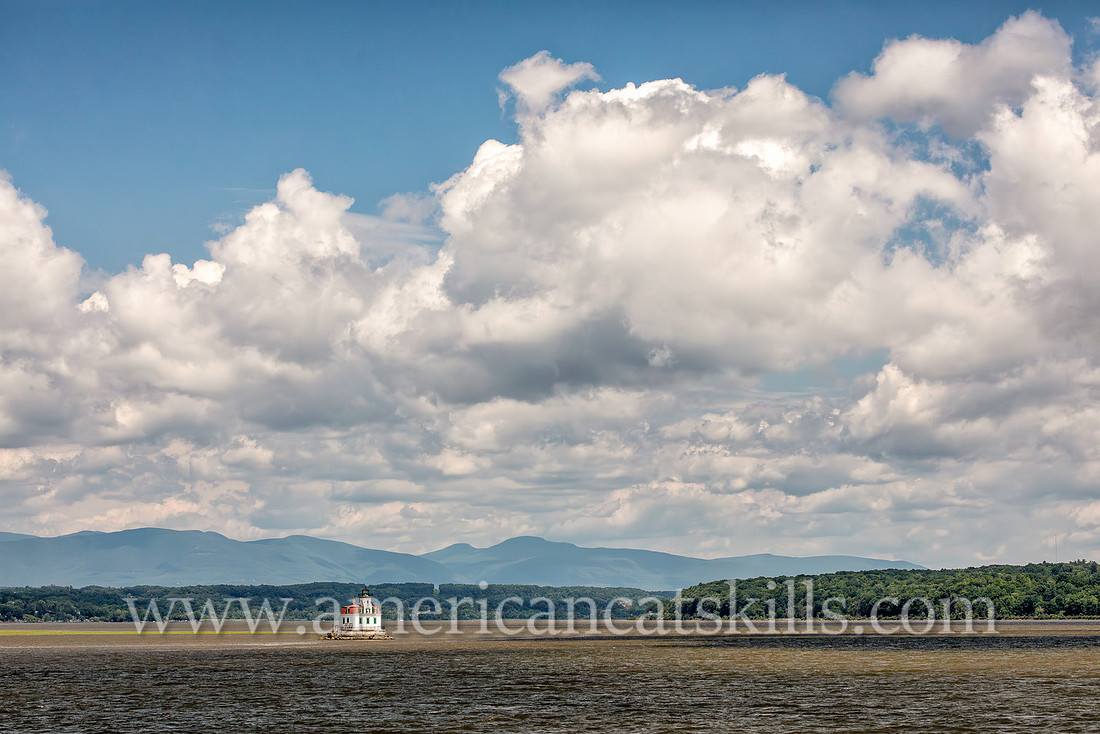
The lighthouse stands on the west side of the channel, in the river, and is accessible only by boat. The lighthouse was originally constructed in order to warn mariners of the tidal mud flats located off the western shore of the Hudson River.

The Name – Meadows
The meadows, from which the lighthouse takes its name, refers to the pastureland that was once located at and around the area where the lighthouse is now located, and reached to the western shore of the Hudson River. The land was used by local farmers as pastureland for grazing by their cows. However, in time, with the changing of the river, the meadows first became accessible only at low tide, and are now fully submerged at any tide.
Of the meadows area, noted archaeologist Robert E. Funk wrote that “There is a distinct possibility, if not probability, that prehistoric (and even historic) sites still exist on ancient benches, terraces, and floodplain deposits below the Hudson's average modern low tide level. An example of this potential is Esopus Meadows . . . which is presently under about two meters of water. Aerial photographs show evidence of stone walls that indicate the area was dry and habitable in early colonial times. There may well be Native American sites on this submerged land mass.” (Funk, Robert E. An Introduction to the History of Prehistoric Archaeology in New York State.)
Once submerged, the area became a grave threat to mariners, as the water where the meadows once stood gave the appearance that the area was navigable, when in reality it was only several feet deep. Historical newspapers featured countless stories of vessels damaged or stranded at the meadows.
Today, according to the Town of Esopus Comprehensive Plan of 2019, “the shallow, subtidal lands provide feeding, breeding, and nursery habitats for many aquatic fish species including Striped Bass and American Shad. A sizable population of shortnose and American sturgeon winter in the adjacent channels of the Meadows and can be found in the area year-round. A significant concentration of waterfowl also occurs in the Esopus Meadows area during spring and fall migrations, attracted by the many valuable feeding areas.
Esopus Meadows is adjacent to the Kingston-Poughkeepsie Deepwater Habitat on the opposite side of the River. The Meadows are one of the most southern locations of freshwater shallows on the Hudson. In recent years the invasive, non-native water chestnut has expanded to the site and has proved problematic to fish species as well as humans who seek to use the river for recreational purposes.”
The Name – Esopus
The historical meaning of the name Esopus varies depending on the source. According to noted historian Alf Evers in his book The Catskills “the word ‘Esopus’ is a Europeanized form of an Algonkian word for a brook or small stream. Dutch settlers applied it to the stream that rises in the Catskills and enters the Hudson at what became Saugerties. The settlers transferred the name to the Indians who lived on its banks and then to the land along the river.”
According to the Historians of Ulster County in their book titled History of Ulster County, With Emphasis on the Last 100 Years, “the Indians called the place “esepu” meaning “high banks” according to some historians and “flowing waters” according to others. Both apply. Town of Esopus is indeed a land of “high banks and flowing waters.” The Dutch settlers named their colony “Esopus” after the Indian name for the area, and called the Indians living here the Esopus Indians.”
The Town of Esopus Bicentennial Committee in their book titled Town of Esopus Story 3000 B.C. – 1978 A.D. “the name Esopus is a Dutch word derived from the Indian language. It means “land of flowing waters and high banks.” “Esopus is said to be a Dutch Latinization of Esepu, the name of the Indians in this area.”
William M. Beauchamp in his Aboriginal Place Names of New York writes that “E-so-pus, once Sopus, was derived by Heckewelder from seepu, the Delaware word for river. Seepus was made equivalent to Sopus, and Esopus was formed from this, being so called in 1655. It sometimes appeared as Sopers. The Indians there were of the Algonquin family, and there would be more force in the alleged origin had they not called the place by another name, and the Dutch invariably by this. It became prominent at an early day.”
Nathanial Bartlett Sylvester in his History of Ulster County, New York wrote that “the territory now included in the town of Esopus was originally known as Cline Esopus, to distinguish it from the larger tract called Esopus, north and west of the Rondout and the Wallkill.”
A Special Time on the River
The following excerpt, written by Tom R. Lake, provides a reimagination of Native American life in the springtime at Esopus Meadows. The essay, titled “The Ancestral Lure of the Hudson Estuary,” is included in The Journey: An Algonquian Peoples Seminar published by the New York State Museum.
“Spring fishing camps must have been a time of contentment. The group had survived another long, cold winter, the river was warming, and the “cooperative” (the river) was open for business. It is possible to visualize the fishing station at Esopus Meadows, RM87, about 4,000 years ago.
There might be a dozen thatched wigwams arranged in a roughly circular pattern. A low hum of voices from women cooking fish and shellfish amidst blue woodsmoke would rise from several hearths and stone ovens. The smells of good food would fill the air. Other members of the group would likely be busy in net-making or in netmending, or would be in woodworking areas, where new dugout canoes were being fashioned from logs. Small children would be laughing and running along the shore, domesticated wolf pups yipping at their heels.
At the edge of camp, a few people would be feeding hemlock boughs to smoky fires over which fresh hides would be stretched. Several cleaned and plucked wild turkeys could be hung from a pole nearby, waiting their turn to be smoked, using the fragrant pignut. Long ragged skeins of Canada Geese and Snow Geese headed north overhead. The chatter of birds and the “fire” color of orioles would highlight the trees under a cloudless blue sky; a white blanket of shadbush bloomed all around.
On the broad floodplain, several dugout canoes would be drawn up on the beach ahead of the rising tide. Families and clans would have set up fish processing racks and smokehouses. (They would have avoided the initial processing of fish and game too near where they were living in deference to black bears and wolves.) Some people would be tending fish weirs made of saplings bound with natural fibers; others would be collecting freshwater mussels from the shallows. Groups of adolescent males and adults would be dragging long nets out of the river, spilling hundreds of river herring and scores of shad onto the beach. Osprey would swoop down to the river’s edge to grab those that were floating away. Nearby, several adult bald eagles would perch on snags waiting their turn at an easy fish dinner.
In time, after the spring spawning migration of shad and herring ended, members of the group would gather up their belongings and head downriver, where the promise of blue crabs, shellfish, and ocean fish awaited them. They would not return to their fish processing spot until next spring, when the pussy willow’s catkins emerged.”
Brief History of the Lighthouse Service
The U.S. Lighthouse Establishment was created by the First Congress in 1789 to manage the 12 colonial lighthouses now controlled by the federal government and to oversee construction of new lighthouses. Sandy Hook Lighthouse, built in New Jersey in 1764, is the only colonial lighthouse that has survived (Boston Harbor Lighthouse, built in 1716, was rebuilt in 1783-1784). Between 1789 and 1820 about 40 new lighthouses were built by the Lighthouse Establishment.
On August 31, 1852, the U.S. Lighthouse Establishment became the U.S. Lighthouse Board, largely due to the numerous complaints about the state of the U.S. lighthouse system. The nine-member board was composed primarily of Naval and Army engineer officers. The country was divided into 12 new lighthouse districts, each with an inspector responsible for overall construction, maintenance and purchasing.
On June 17, 1910, the U.S. Lighthouse Board became the Bureau of Lighthouses. The number of districts was increased to 19.
In 1939, the Bureau of Lighthouses was abolished and its functions were transferred to the U. S. Coast Guard. At the end of World War II, the Coast Guard staffed 468 light stations.
Following the war, the Coast Guard embarked on a program of automation. The rationale for the programs was to reduce the cost of maintaining lighthouses, to remove personnel from extremely isolated and hazardous locations and to make billets available for programming. Despite these efforts, the Coast Guard “manned” 27 lighthouses in 1962. The Coast Guard then initiated the Lighthouse Automation and Modernization Program in 1968. LAMP was designed to accelerate and standardize the remaining lighthouses for automation and to standardize the equipment at those previously automated.
Every Coast Guard-owned lighthouse in the United States was then automated and unmanned, with the sole exception of the Boston Lighthouse. In November 1989, just as the Coast Guard was preparing to automate the Boston Light on Little Brewster Island, the US Senate passed a law sponsored by Senator Kennedy requiring that Boston Light be permanently manned. Boston Light thus became the only manned lighthouse in the United States.
The law also required that public access to Little Brewster be facilitated, and this occurred during the 1990s, culminating with the official opening of the island to the public in 1999. The light was finally automated in 1998, again the last one in the country, and now remains always “on,” ending the keeper’s having to climb the stairs twice a day.
In 2003, Dr. Sally Snowman became the first civilian keeper at the Boston Lighthouse since 1941. After 20 years, Dr. Snowman retired in 2023. Snowman served as the last official lighthouse keeper in the United States.
The First Lighthouse at Esopus Meadows
The opening of the Erie Canal in 1825 brought about a boom in shipping along the Hudson River. The 363-mile man-made canal traversed the state of New York, connecting Lake Erie at Buffalo to the Hudson River at Albany. The canal enabled agricultural products from the northwest to make their way to ports in New York. After the Delaware and Hudson Canal opened in 1828, coal from Pennsylvania was shipped to Kingston for distribution in the east, making the need for navigational aids on the upper Hudson River even more important. Commercial river travel became an integral part of the development of the communities along its shores.
In 1831, due to ongoing danger posed by the tidal mud flats at Esopus Meadows and the growing need for improved navigation along the Hudson River, the U. S. Congress appropriated $3,000 for "erecting a beacon light at the junction of Rondout Creek and Hudson River, or on or near the Esopus Meadows, as may be deemed most expedient by the Secretary of the Treasury." Despite the allocation of funds, the lighthouse was not constructed at that time.
In 1837, the U. S. Congress again appropriated $3,000 for the construction of a lighthouse at Esopus Meadows. However, the following year, in 1838, it was reported that “for the light-house at Esopus Meadows, on the Hudson River, three thousand dollars only were appropriated; it will require at least six thousand dollars; and, consequently, nothing has been done in relation to it. The proper site is inundated at high tides, rendering it necessary to place the building on a pier so strong as to resist the floating ice in the spring of the year.”
In 1838, the U. S. Congress appropriated the additional $3,000, for a total of $6,000, to construct the lighthouse. The site for the lighthouse was acquired from local farmer George Terpening for the sum of one dollar.
In 1838, advertisements were placed in local newspapers seeking proposals to build the new lighthouse at Esopus Meadows. These advertisements offer great insight as to the description, layout and construction of the lighthouse.
“Custom House. Collector’s Office, New York. 16th July, 1838. Proposals will be received at this Office until the 4th day of August next, at noon, for BUILDING A MOLE and LIGHT HOUSE, on the point of the Flat, at Esopus Meadows, where the water at low tide is about one and a half feet deep, of the following materials, dimensions, and description, viz:
1st. To build a Wharf, forming a square to the south end 40 feet by 50 feet, and from the two north corners to a point at the extent of 50 feet from the said square in a direct north line. Said Wharf to be formed on the outsides with white pine timber of not less than one foot, hewed on three sides, and laid on a slant of 30 degrees, and secured with braces in the area. The height to be five feet above high water mark, and inside of the timber seven oak spiles eighteen inches in diameter, placed at proper distances apart, the same to be well driven into the ground, and in height four feed above the top of the Wharf. The area thus formed to be filled with stone as high as the top of the timber. On the outside of the timber to be planked with oak plank three inches thick, one end driven well into the ground, and spiked into each timber to the top of the Wharf.
The mole to be 50 feet long and 40 feet wide. The walls of stone, four feet thick at the bottom, two at the top, and to rise four feet above the average high water mark. The walls to be leveled off with large flat stones, and the filling to be raised crownwise in the center of the Mole. Within the area is to be made the foundation of the house, which is to be thirty four feet long and twenty wide. The foundation walls of the Dwelling and Lighthouse to be two feet thick, of split stone, laid in lime mortar, and carried up to within three feet of the top of the Mole walls. The space between the Mole walls and those of the house to be filled up with stones, gravel, sand or earth. The exterior of the Mole walls to be well backed up with earth, level with the foundation walls of the house.
The Dwelling house to be built of split stone, thirty four feet long and twenty wide, two stories, each eight feet high; the lower story to be divided into a kitchen, store and oil rooms, with a pantry and the entries between; stairs in the front entry to go into the second story, which is to be divided into 2 rooms, with closets, and an entry between them, from the latter stairs to go into the chambers, which are to be lathed and plastered; a chimney in each end of the house, with fire places in the kitchen, and the two rooms in the second story, iron or stone mantel pieces, an oven in the kitchen, with an iron door; crane, trammels, and hooks; a sink on one side of the fire place, with a spout leading through the wall; doors in the front and rear entries. The walls of the house to be two feet thick; laid in lime mortar; the roof to be rectangular, the boards of which to be well jointed and halved, and well secured and covered with imperial slates; two windows of sixteen panes of 8 by 10 glass in the kitchen, one in the oil and store rooms, three in each room of the second story, and one in each chamber; the doors to be four paneled, with good hinges and thumb latches to each, and a good lock on the outside doors; all the doors to be double and well nailed; the inside walls and ceiling of the apartments to be lathed and plastered, and all the inside work to be finished in a plain decent style with seasoned lumber. All the wood work, inside and out, to be covered with two good coats of paint; gutters to lead round the house, with spouts to carry off the water; an outhouse, five feet by four, well shingled and painted.
On the center of the house to be an octagon tower, eight feet in diameter, and to rise two feet above the ridgepole of the House; the poles to be ten inches square, to stand on the beams of the house, and well secured together by girths and braces, the former to be ten inches square; the outside above the roof the house to be boarded and slated; on top of the tower a deck ten feet in diameter, formed of three inch planks, on which is to be laid tarred sheathing paper, and that covered with heavy capper, well secured to the deck with copper nails; in one side of the deck a scuttle to enter the lantern, the scuttle doors to be made of double boards, and covered with copper like the deck; one window in the upper story of the tower, of twelve lights, of ten by eight glass, a sufficient number of steps to lead from the attic chamber of the house to the entrance of the scuttle, with a railing thereto.
An iron lantern of the octagon form, the posts to be one and half inch square, and to pass through the deck four feet, and bolted on to the posts of the tower; the height and diameter to be sufficient to admit an iron sash in each octagon to contain eighteen lights, nine by twelve; the lower tier to be filled with copper, the rabbets of the sashes to be three quarters of an inch deep, and to be glazed with the best double glass of the Boston manufactory; in one of the octagons an iron framed door covered with copper, two feet by four, to shut tight into rabbets, with to strong turn buttons; the top to be a dome formed by sixteen iron rafters concentrating into an iron hoop four inches wide, and nine inches diameter, covered with thirty ounce copper, which must come down and rivet on the piece that forms the top of the sash, which is to be three inches wide; on the top a traversing ventilator, two and half feet long, and fifteen inches diameter, on which must be secured a copper vane three feet long and twenty inches wide – the lantern to be guarded by an iron railing, the posts to be one and a quarter inches square, the upper one to be four feet above the deck; the house to have one complete electrical conductor, made of copper, three quarters of an inch in diameter, pointed at each end, and enter the ground five feet, at an angle of about 45 degrees; the lantern, door and windows of the tower to be painted twice over, white inside and black outside.
Separate proposals will be received for fitting up the said lantern, after it shall be built, with five patent lamps, and fourteen inch reflectors, and to furnish one spare lamp, six tin butts of 80 gallons each, for keeping the oil, with tin covers to each, and all necessary apparatus, in the same manner as the lighthouses in the United States have been fitted by Mr. Winslow Lewis. The whole to be approved by the superintendent of the establishment, or such other person as may be designated by him. Payment to be when the work shall be completed and approved, and not before.
The work to be commenced by the 25th of August next, and finished within three months thereafter. All the materials to be of the best king. J. HOYT, Collector and Superintendent of Lighthouses for this District.”
The work was scheduled to be completed in December 1838, but an early frost delayed final construction. Ried Clapp was the contractor for the job. As per the proposal notices in the local newspapers, Clapp would not be paid for his work on the lighthouse until the job was completed.
The Esopus Meadows Lighthouse became active in June 1839, with Jeremiah Terpenning serving as the first lightkeeper from 1839 to 1842. After his years of service at the lighthouse, Jeremiah became a farmer in the town of Esopus.
In 1844, the lighthouse inspector reported that the lighthouse had five lamps with all the necessary supplies. He also wrote that “this light is well kept. The reflectors are much worn; and I would advise the same arrangement with the lantern as that proposed at Stony Point.”
In 1850, it was reported that “this building, which stands on a pier, has not had any repairs the last two years. It is in somewhat of a dilapidated state, but is now kept clean, and the lighting apparatus is now is good burning order.” The lighthouse had four lamps. Supplies on hand included 114 gallons of spring oil, 24 gallons of winter oil, 20 tube glasses, 2 gross wicks, 20 yards of cloth, 1 buff skin, 1 box of soap, 1 box of Tripoli, 1 pair of scissors, and 1 wick box. There were also two spare lamps, both in good working order, common burners and 16-inch reflectors. The inspector also gave the lighthouse keeper an oil-cask to keep water in.
By 1855, it was reported that the pier at the lighthouse was suffering damage due to ice coming from the south, and it was therefore proposed to add a south-facing triangular extension to the pier to act as an icebreaker. “This pier, which is nine feet high above the bottom, is 41 by 50 feet, with an angular extension to the northward of 50 feet for an ice-breaker. The southern extremity of this pier has been much injured by ice coming from that direction and acted upon by southeast wins, and the current of flood. Elsewhere it appears to be in good order. It is proposed to add to this pier a triangular extension on its south end to protect it from further damage by ice from that direction, constructed of squared timber and ties, resting upon piles solidly driven into the ground, with a facing of 3-inch chestnut plank, protected at the angles by stout iron bands and sheet-iron, and the whole filled with stone.”
Advertisements were placed in local newspapers seeking proposals for the pier repairs. “To Contractors. Proposals will be received at this office until the 10th of June next, for . . . “the repair of Light-House Piers in the Hudson River, at Esopus Meadows, Rondout, Saugerties Coxsackie Island and Stuyvesant. The plans and specifications relative to these works can be examined at this office after the 27th inst., between the hours of 12 and 3 P. M. G. DUTTON, Captain U. S. Corps of Engineers, New York, May 23, 1856.” The work was completed in 1857 at a cost of $696.
After nearly three decades of use, continuous flood tides and ice flows significantly weakened the lighthouse foundation, making it unsafe for use. By 1867, it was reported that the lighthouse was “in a ruinous condition,” and it was proposed to rebuild the lighthouse “on the plan already adopted for other stations on the Hudson.”
In 1869 it was reported that “this station is in an exceeding bad state, and the only economical remedy is to rebuild the light-house. The wooden pier upon which this light-house stands is in such a dilapidated state that it is feared the whole will be taken away by the ice and freshets during the coming winter. The keeper’s house is unfit for occupancy in the winter, even if the foundation pier were safe enough to justify its occupancy.”
The last lighthouse keeper at the first Esopus Meadows Lighthouse was Charles M. Yates, who served from 1866 to 1870.
The Second Lighthouse at Esopus Meadows
With the imminent demise of the first lighthouse, it was decided to construct a new lighthouse at the same location. The U. S. Congress appropriated $25,000 for the work on July 15, 1870. The Lighthouse Board determined that the money had become available too late in the working season of 1870 to allow for construction to proceed to the point where the lighthouse could “resist the winter storms and ice of the spring.” Therefore, the start of construction was delayed to the spring of the following year, in 1871. The new lighthouse was located 100 feet southeast of its original location.
The contract for building the new lighthouse at Esopus Meadows was awarded to R. C. Bloom, an architect, William Gage, a dock-builder, and Frank Malden. The Rondout Freeman reported the cost to be about $22,000 and that work would begin in July 1871. The lighthouse beacon was officially lighted in August 1872.
Jonathan Cole served as the first lighthouse keeper of the second Esopus Meadows Lighthouse. Cole would become the longest serving keeper in the history of the lighthouse, serving for 15 years from 1870 to 1885.
With the construction of the new lighthouse, proposals were solicited for the sale and removal of the old stone dwelling, but no proposals were received. Therefore, the old lighthouse was torn down in 1873, with the remaining stone being used around the base as riprap.
In 1891, a fog bell was added to the Esopus Meadows Lighthouse. The bell was designed to be struck by machinery every ten seconds in thick or foggy weather.
The Esopus Meadows Lighthouse was considered a family station because it could not be manned from shore. It was only accessible by water, so for the entirety of its operation it always had a keeper in residence. After the Coast Guard acquired the Lighthouse Service in 1939, the keepers and their families were gradually replaced by Coast Guard personnel.
Lighthouse keepers continuously kept guard over the river at the Esopus Meadows Lighthouse until its automation by the Coast Guard in 1965. The last entry in the station log reported that the main light was extinguished at 6:37 am on Tuesday, August 17, 1965.
With the 1965 automation, the three-man crew from the Coast Guard, including Alfred Vaughn, Stanley Fletcher and Lawrence Lutackas, were reassigned from their official duty at the lighthouse to other locations. Wood boards were placed over the glass windows and then painted to resemble curtained windows.
With the automation, the light was changed to flash white every 10 seconds with a half second flash of 8,000 candlepower on bearings of 155 on 010 degrees, diminishing to 800 candlepower around the remainder of the horizon 52 feet above the water.
The Coast Guard then added a light nearby with a steel pole type beacon, with plans to demolish the Esopus Meadows Lighthouse. In 1966, U.S. Coast Guard Captain R. A. Schultz commented that “The present structure has been surveyed and found to be uninhabitable. It is beyond economical repair for our uses, and so will be razed later this year.” (Barrytown Explorer. February 1, 1966.)
Fortunately, the plans to demolish the lighthouse were put on hold when the Hudson River Valley Commission expressed its interest in preserving the historic structure. The Commission estimated that it would take approximately $45,000 to renovate the lighthouse and settle its foundation. The required funding was never raised and the work was never completed by the Commission.
Over the following decades, despite the preservation plans, but without on-site keepers, the lighthouse fell into a sad state of disrepair. Seasonal ice floes continued to damage the structural foundation of the lighthouse, with its foundations settling unevenly.
Restoration
Twenty-five years after its closing, in 1990, the Save Esopus Lighthouse Commission (SELC) leased the lighthouse from the United States Coast Guard for the purposes of restoration. The SELC eventually took ownership of the lighthouse in 2002, as part of the pilot program for the National Historic Lighthouse Preservation Act (NHLPA).
Under the provisions of the National Historic Lighthouse Preservation Act (NHLPA) of 2000, there was “a mechanism for the disposal of Federally-owned historic light stations that have been declared excess to the needs of the responsible agency.” The NHLPA recognized “the cultural, recreational, and educational value associated with historic light station properties by allowing them to be transferred at no cost to Federal agencies, State and local governments, nonprofit corporations, educational agencies, and community development organizations.”
Any eligible entity that received ownership of a lighthouse had to comply with conditions set forth in the NHLPA and had to be financially able to maintain the historic light station. The eligible entity to which the historic light station was conveyed had to make the station available for education, park, recreation, cultural, or historic preservation purposes for the general public at reasonable times and under reasonable conditions.
The SELC conducted extensive renovations over the years at the Esopus Meadows Lighthouse. Perhaps most importantly, the building, which was significantly leaning, underwent significant structural repairs to level and stabilize the lighthouse. Other work included restoration carpentry work, repairing the roof, replacing windows, painting the interior and exterior of the building, adding a concrete cap to the lighthouse pier, installing a floating dock to allow larger vessels to stop at the lighthouse and much more.
On May 31, 2003, at 8:20 pm, after 38 years of darkness, the tower light again became an active navigational aid to guide vessels on the Hudson River. Stanley Fletcher, one of the last three Coast Guard members who worked at the lighthouse in 1965 when it was decommissioned, had the honor of throwing the switch to turn on the light in a special ceremony that was widely attended. Fletcher (1931-2015) was a retired US Coast Guard Engineman First Class.
The Esopus Meadows Lighthouse is twice listed on the National Register of Historic Places, once as its own entry and a second time as part of the Hudson River Lighthouses Thematic Group. Other lighthouses within the thematic group include Jeffrey's Hook Lighthouse, Tarrytown Lighthouse, Stony Point Lighthouse, Esopus Meadows Lighthouse, Rondout Lighthouse, Saugerties Lighthouse and the Hudson/Athens Lighthouse.
Albert Richard Dow (1849-1922)
The second Esopus Meadows Lighthouse was designed by Albert Richard Dow, a prominent Vermont engineer. Dow was born in Burlington, Vermont on March 21, 1849, the son of Isaac and Frances (Scott) Dow. Dow studied civil engineering at the University of Vermont, graduating with his Bachelor of Arts degree with the class of 1870, his Civil Engineering degree in 1872 and his Master of Arts degree in 1873.
While attending the University of Vermont, the Lighthouse Service announced a national competition for architects and engineers for possible designs of a future lighthouse. Entries were received from across the Unites States. Despite the high level of competition, the winning design was submitted by Dow. Other lighthouses designed by Dow include the Colchester Reef Light (Vermont), the Rose Island Lighthouse (Rhode Island), the Sabin Point Light (Rhode Island) and the Pomham Rocks Lighthouse (Rhode Island).
Dow was an instructor at Burlington High School in 1870-1871, served as the superintendent of lighthouse construction from 1872 to 1877 and worked as the Burlington city engineer and superintendent of streets from 1878 to 1892. He also worked on the Chicago, Santa Fe and California Railroad in 1877-1878. He later opened his own Civil Engineering and Surveying company in Burlington.
Albert Dow passed away suddenly early in the morning on June 18, 1922 and is buried Lakeview Cemetery in Burlington, Vermont. He was survived by two sons, Charles S. Dow, of New Haven, Connecticut, and Arthur W. Dow, of Burlington, Vermont.
The Second Lighthouse Building
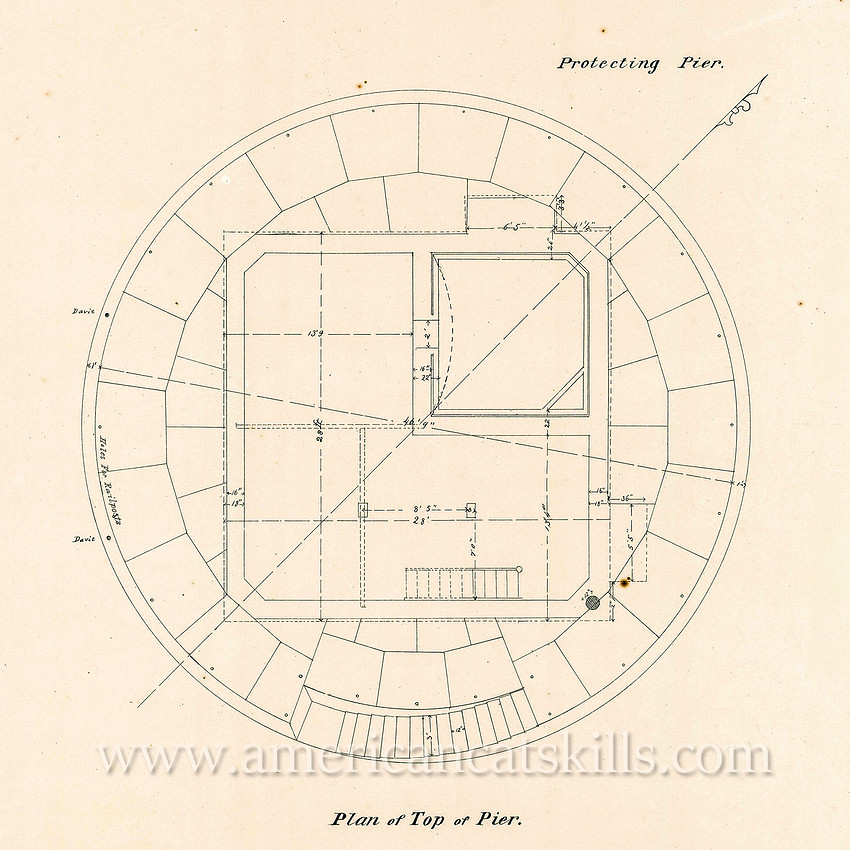
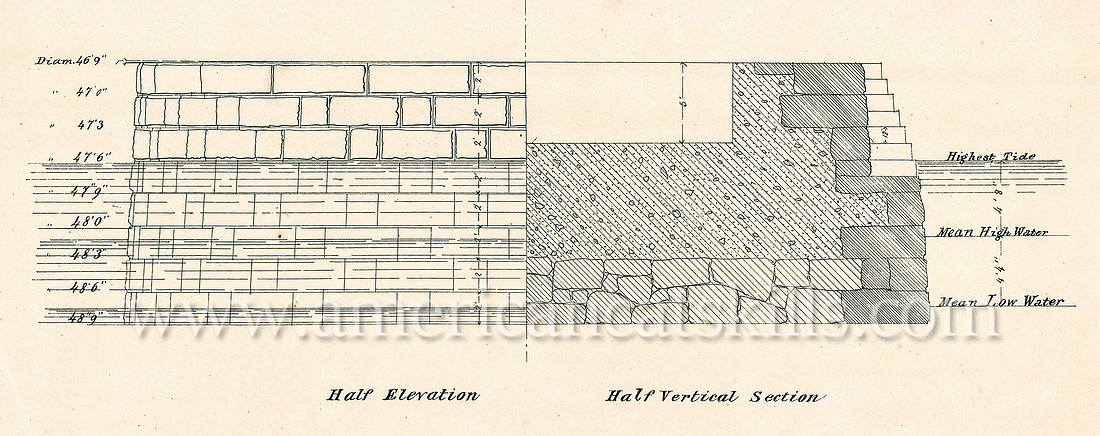
The Esopus Meadows Lighthouse was built on a new foundation that was laid on top of a circular granite pier with 250 40-foot-long piles driven down into the riverbed. The piles were cut off three feet below the mean water line and were then capped with 12-inch square timbers and topped with a deck of 3-inch pine. Granite blocks where then piled on top to a height of 16 feet, with the finished round pier measuring 49 feet in diameter at the base and 46 feet at the top.
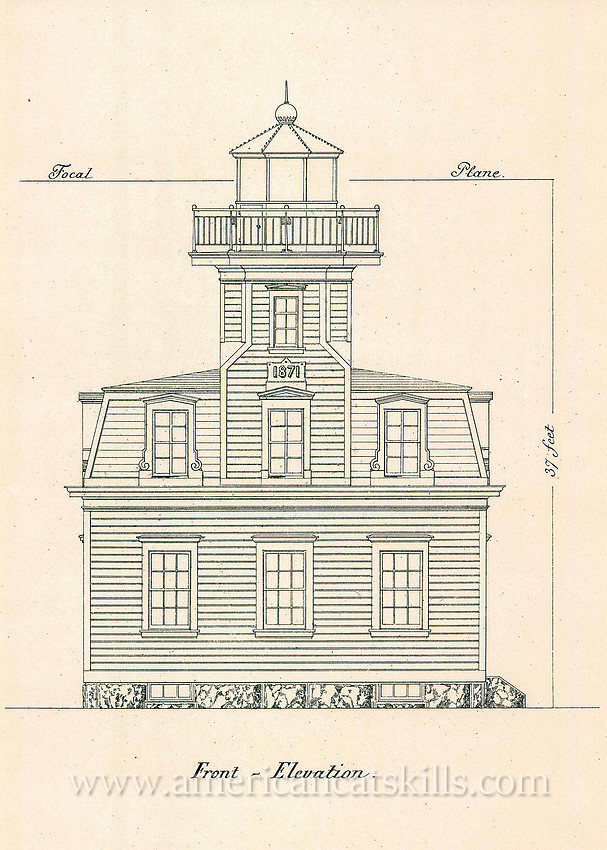
The dwelling and tower, built on this new pier, were painted white, the Mansard roof was of a slate color, and the lantern was painted black.
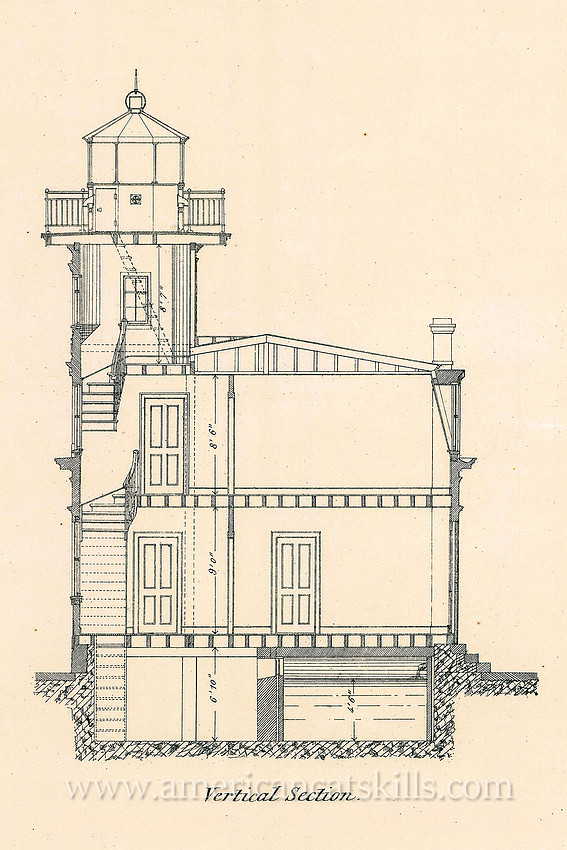
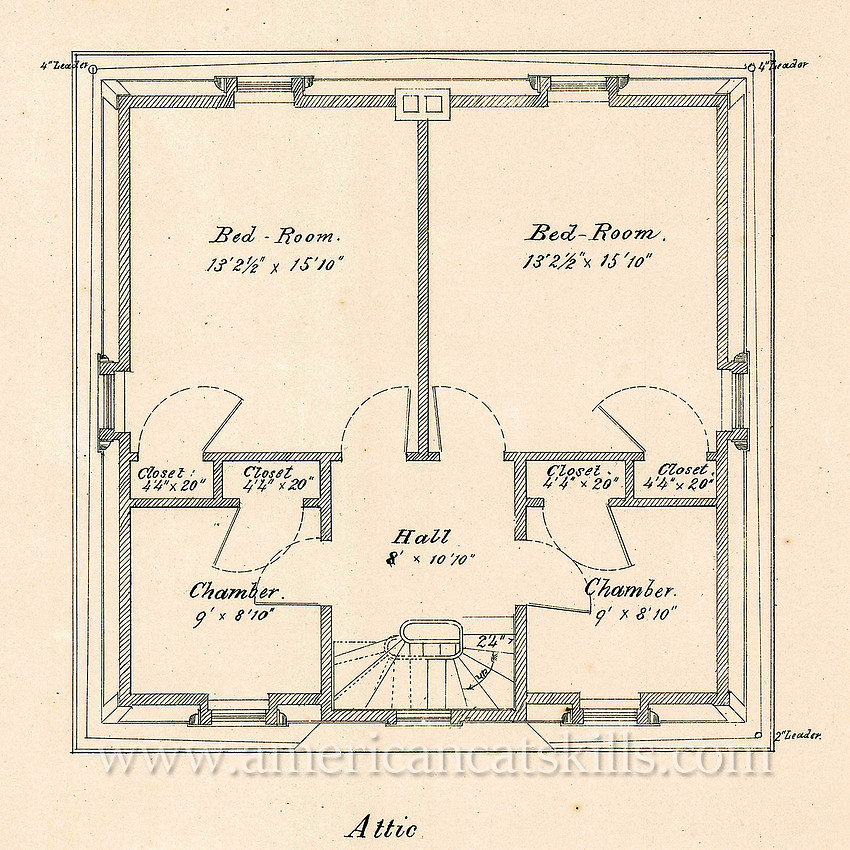
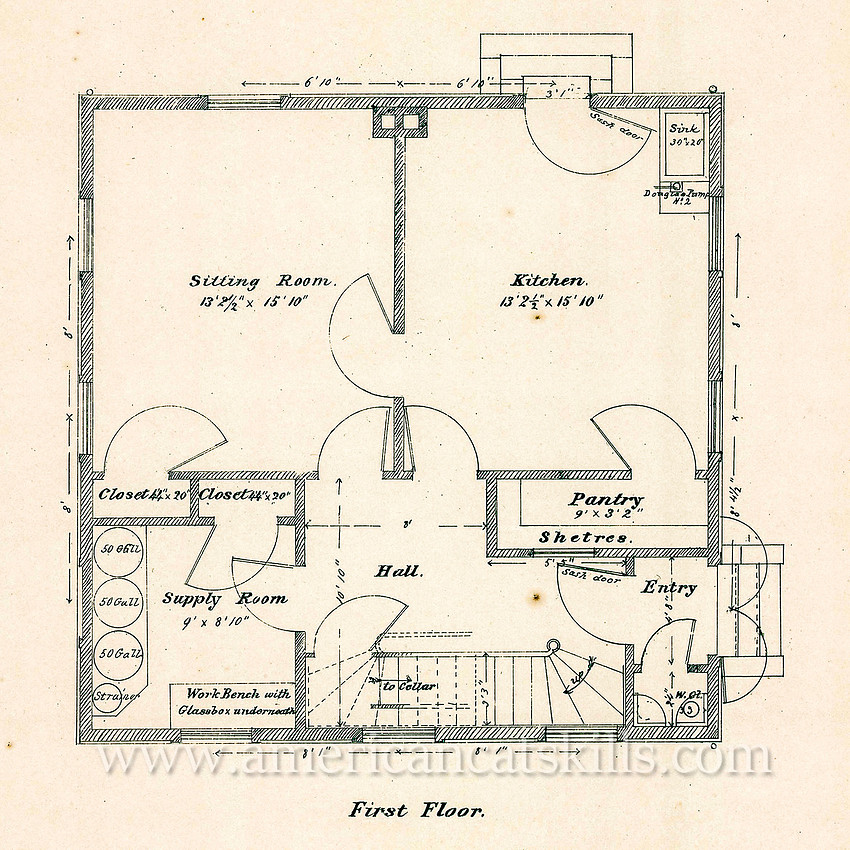
The first floor of the lighthouse contained a kitchen, a pantry, a sitting room, and a supply room; while the second floor contained two bedrooms, closets and two other “chamber” rooms that served various functions over the years. The bedrooms measured 13 feet 2 inches by 15 feet 10 inches; while the “chamber” rooms measured 9 feet by 8 feet 10 inches. The second floor also provided access to the tower. A beautiful staircase with a black walnut banister and spindles wound up to the tower.
As per the National Register of Historic Places, the Esopus Meadows Lighthouse is a “wood frame building set on stone rip rap. It is painted white with a red mansard roof. The tower and the lantern room extends through the roof of the southeast façade. An octagonal deck surrounds the lantern room. There is a total of fifteen windows, six of which are roof dormers.
There are three bays on each of the northeast and southeast facades. There are two bays on the northwest and the southwest facades. There are two entrances to the building, one in the northwest façade and the other in the northeast façade. The detailing around the windows and doorways is in the Second Empire style.”
The beacon apparatus was dioptric, of the 5th order of Fresnel, and illuminated an arc of 270 degrees of the horizon, with a fixed white light. The focal-plane was 58 feet above the river, and the light could be seen in clear weather for 12 nautical miles.
The Esopus Meadows Lighthouse is the only remaining Hudson River lighthouse to be built with a wood frame and sheathed in clapboard.
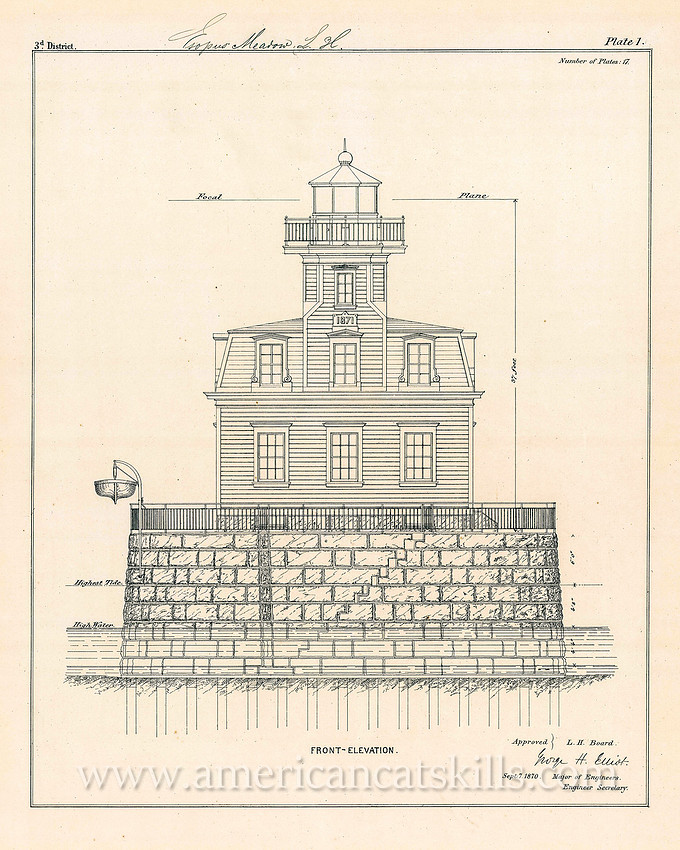
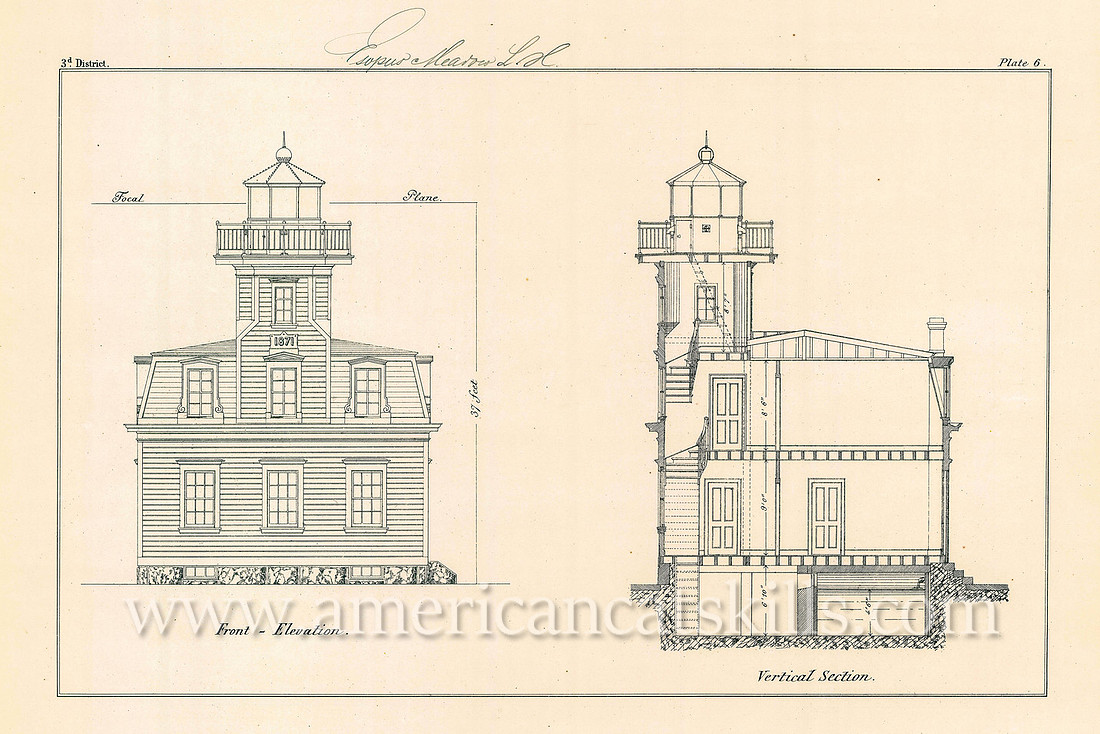
For those seeking additional architectural details about the Esopus Meadows Lighthouse, the National Archives (www.archives.gov) contains 17 architectural and engineering drawings of the structure. The 17 drawings, which are available online, include:
- Plate 1: Front Elevation
- Plate 2: Foundation and Horizontal Plans
- Plate 3: Pier Plan
- Plate 4: Base and First Floor
- Plate 5: Attic, Lantern Deck and Watch Room
- Plate 6: Front Elevation and Vertical Section
- Plate 7: Framing Details
- Plate 8: Framing Details
- Plate 9: Northeast and Southwest Sides
- Plate 10: Southeast and Northwest Sides
- Plate 11: Windows
- Plate 12: Doors
- Plate 13: Kitchen Entrance and Storm Doors
- Plate 14: Dormer Window
- Plate 15: Lantern Railing and Wrought Iron
- Plate 16: Railing
- Plate 17: Half Vertical and Half Elevation
How To Visit
There are several ways to view the Esopus Meadows Lighthouse. From land, visitors can visit Lighthouse Park, a riverfront park that offers superb views of the Hudson River, including the Esopus Meadows Lighthouse. A trail connects Lighthouse Park to the adjacent Esopus Meadows Preserve, which offers two miles of hiking trails. Lighthouse Park is located at 255 River Road in Ulster Park, New York.
Other land views of the lighthouse can be had from the east side of the Hudson River at the great lawn at Mills Mansion in Staatsburg or the great lawn at the Wilderstein Historic Site in Rhinebeck.
By water, visitors can take a wonderful sightseeing boat cruise from Hudson River Cruises, located at 1 East Strand Street in Kingston, New York. The 90-minute cruise offers great views of both the Rondout Lighthouse and the Esopus Meadows Lighthouse, scenic views of waterfront mansions and other sites along the Hudson River. Visit their website at www.hudsonrivercruises.com for more information.
Alternatively, the Hudson River Maritime Museum offers a 2-hour cruise that sails by both the Rondout Lighthouse and the Esopus Meadows Lighthouse. The museum is located at 50 Rondout Landing in Kingston, New York. Visit their website at www.hrmm.org for more information.
Selected Sources
D’Entremont, Jeremy. The Lighthouse Handbook: Hudson River & New York Harbor. Kennebunkport, Maine: Cider Mill Press Book Publishers, 2009.
“Esopus Meadows Lighthouse – Town of Esopus, NY.” Hudson River Lighthouses. www.hudsonriverlighthouses.com.
“Esopus Meadows Lighthouse.” Lighthousefriends.com. www.lighthousefriends.com.
Esopus Meadows Lighthouse. National Park Service, nomination form for inclusion on the National Register of Historic Places, Washington D.C. 1979.
“Esopus Meadows Lighthouse.” US Lighthouses. www.us-lighthouses.com.
Glunt, Ruth R. Lighthouses and Legends of the Hudson. New York: Library Research Association, 1975.
Hudson River Valley Commission of New York. The Hudson River Lighthouses, September 1967.
National Archives. www.archives.gov.
United States Lighthouse Society. www. www.uslhs.org.
